How to test the Delta P sensor, pressure tubes, and verify a DPF restriction before replacing the filter?
A high DPF differential pressure reading on a Volvo D13 does not automatically mean the DPF is plugged. The ECM calculates differential pressure (Delta P) by comparing exhaust pressure before and after the diesel particulate filter. If the pressure difference becomes too high, the truck may set a DPF differential pressure fault such as SPN 3251 and may experience frequent regeneration, reduced performance, or derate conditions.
But there is another possibility: the DPF pressure sensor may be reporting a high value because one of its pressure tubes is restricted with soot, contaminated, kinked, damaged, or affected by condensation.
That is why the sensor and its pressure lines should be checked before condemning the DPF itself.
How the Volvo D13 DPF Differential Pressure Sensor Works
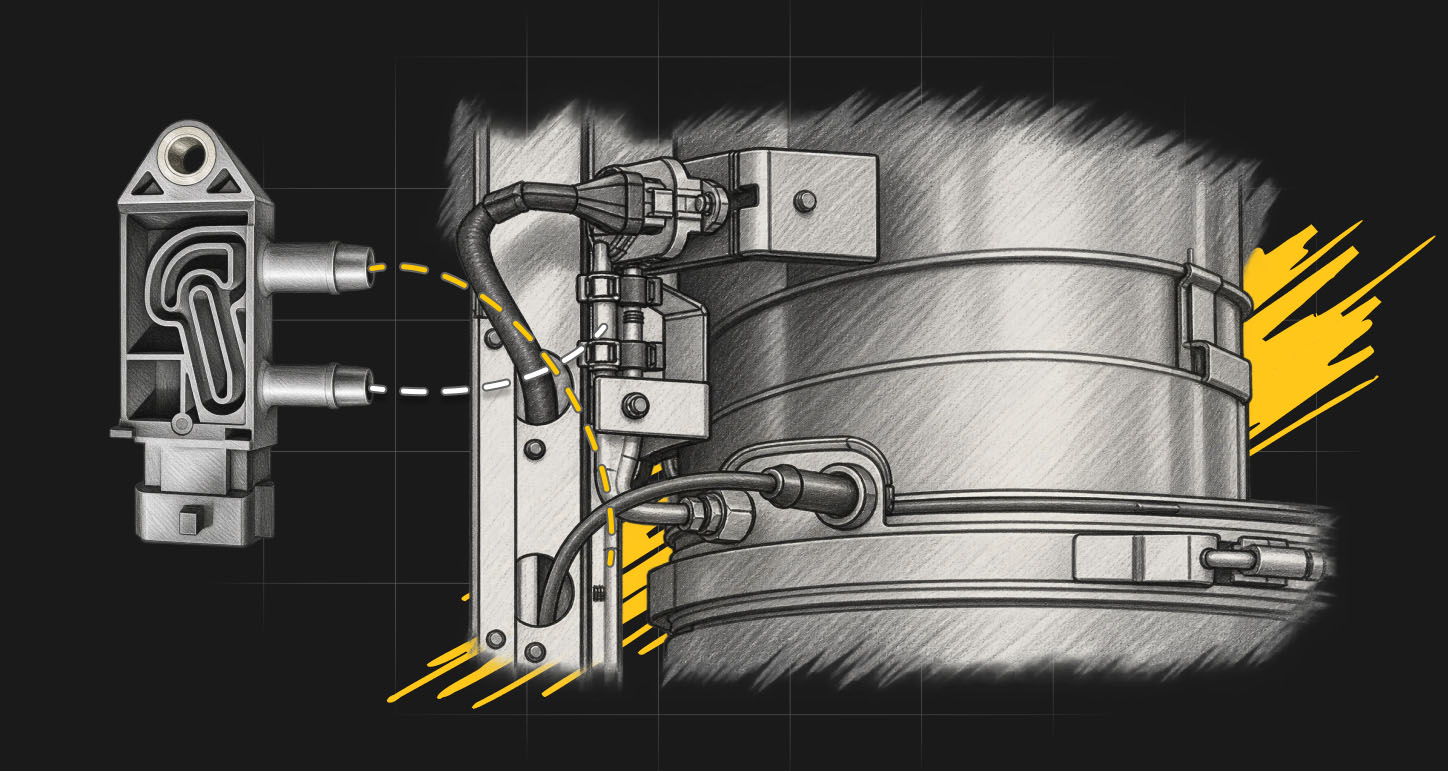
The DPF differential pressure sensor is connected to pressure points on both sides of the DPF through small pressure tubes.
One side of the sensor receives pressure from the upstream side of the filter, while the other receives pressure from the downstream side.
The sensor determines the difference:
Delta P = upstream exhaust pressure − downstream exhaust pressure
As soot accumulates inside the DPF, exhaust flow becomes more restricted and the pressure difference increases.
Under normal conditions, the differential pressure should be relatively low, especially with the engine off. As engine load and exhaust flow increase, Delta P should also change.
This relationship is important for diagnosis.
If the pressure reading is high when there is little or no exhaust flow, the problem may not be the DPF at all.
A blocked pressure tube can create a false pressure reading and make a healthy filter appear restricted.
Symptoms of a Volvo DPF High Differential Pressure Problem
A problem with the DPF pressure measurement system may produce several symptoms:
SPN 3251 or a related DPF differential pressure fault
DPF warning on the dashboard
Frequent or unsuccessful regeneration
Increasing calculated soot load
Engine power reduction
Derate
Abnormally high Delta P in PTT
Delta P that does not respond normally to changes in engine speed or load
However, these symptoms should not automatically be interpreted as proof of a failed or plugged DPF.
A high differential pressure code can have several possible causes, including:
A genuinely restricted DPF
A clogged pressure tube
A restricted pressure fitting or port
A kinked or damaged pressure hose
Incorrectly connected pressure lines
A contaminated or defective differential pressure sensor
Wiring or connector problems
An exhaust leak or another aftertreatment problem affecting pressure measurement
OEM diagnostic procedures similarly call for inspection of the pressure sensor, connections, pipes, and possible blockages before replacing aftertreatment components.
Volvo D13 Delta P Sensor Testing: Start With the Data
Before removing anything, connect Volvo Premium Tech Tool (PTT) and look at the live data associated with the DPF differential pressure sensor.
The first question is simple:
What does Delta P show with the engine off?
With no exhaust flow, the differential pressure should be close to zero. A significant pressure reading at key-on/engine-off is a reason to investigate the measurement system before blaming the DPF.
Then compare the Delta P value with engine speed and load.
A healthy pressure measurement system should show a logical relationship:
Higher exhaust flow → higher differential pressure
If the value is fixed, implausibly high, extremely unstable, or does not respond logically to engine operating conditions, investigate the sensor and pressure tubes.
PTT is the preferred diagnostic tool for Volvo engine systems and provides access to the relevant diagnostic data and service routines.
Step 1: Inspect the Volvo DPF Pressure Tubes
Before testing the sensor electrically, inspect both pressure lines.
Follow each tube from the DPF/aftertreatment assembly to the differential pressure sensor.
Look for:
Soot accumulation
Carbon deposits
Internal blockage
Kinks
Cracks
Melted sections
Loose connections
Incorrect routing
Damaged fittings
Condensation or moisture
Blocked pressure ports
Pay particular attention to the small openings where the pressure tubes connect to the exhaust system.
A tube can look perfectly normal from the outside while being almost completely restricted internally.
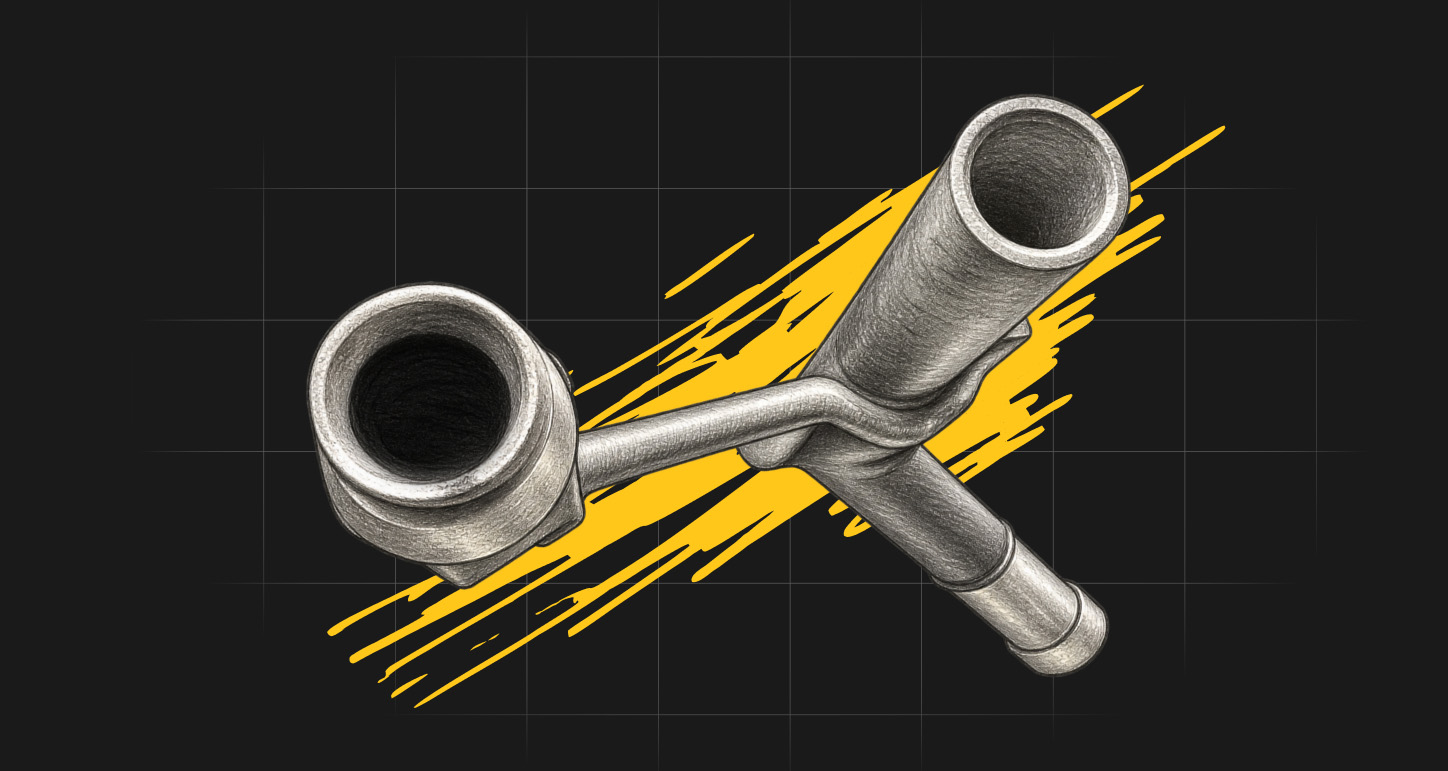
Why a blocked tube can create a false high Delta P
The differential pressure sensor does not know whether the pressure reaching it is coming from the DPF or being trapped inside a restricted tube.
If a pressure line becomes blocked, the pressure signal can become delayed, distorted, or incorrect.
This is one reason a technician can replace a sensor — and sometimes even suspect the DPF — without solving the original problem.
SPN 3251 should therefore be treated as a diagnostic starting point, not as automatic proof of DPF failure.
Volvo DPF Pressure Tube Clogged: How to Check It
After the exhaust system has completely cooled, disconnect the pressure tubes according to the applicable service procedure.
Inspect the tube openings and fittings for carbon or soot.
If a tube is suspected to be restricted, it needs to be cleared using a method appropriate for the specific Volvo aftertreatment configuration.
Do not force large amounts of debris toward the DPF or the pressure sensor.
If a tube cannot be properly cleaned or is damaged, replacement is preferable to reinstalling a questionable line.
Volvo service information for pressure-sensing systems specifically emphasizes checking pressure lines and ports for soot blockage and replacing tubes that cannot be adequately cleared.
Do not forget the pressure ports
Cleaning only the hose is not enough.
The small pressure passage on the exhaust side can also become restricted with soot.
Therefore, inspect:
DPF pressure port → fitting → tube → sensor connection
on both sides of the differential pressure system.
A restriction anywhere along this path can affect the Delta P value.
Step 2: Test the Volvo DPF Differential Pressure Sensor
Once the tubes and fittings have been inspected, the sensor itself can be checked.
There are two useful approaches:
1. Electrical testing with a multimeter
Depending on the specific D13 generation and sensor configuration, the differential pressure sensor will have a supply, ground/return, and signal circuit.
With the connector attached or disconnected as required by the applicable wiring diagram and test procedure, verify:
Do not rely on a generic sensor voltage number taken from another truck or another OEM.
The correct voltage range should come from the diagnostic information for the specific Volvo D13 configuration being tested.
2. Testing through PTT
PTT provides a more useful real-world check because you can compare the sensor's reported value with actual operating conditions.
Check Delta P:
With ignition on and engine off
At idle
At increased engine speed
Under load, if required by the diagnostic procedure
The important thing is not simply whether the number is "high."
The important question is whether the reading makes physical sense.
High Delta P vs. a Blocked Pressure Tube
This is where the diagnosis becomes much easier.
Observation | Possible cause |
| |
High Delta P with engine off | Sensor bias, wiring issue, trapped pressure, blocked tube |
Normal KOEO reading but very high Delta P under load | Actual DPF restriction or pressure measurement problem |
Delta P remains almost unchanged with RPM | Sensor/tube problem should be investigated |
Delta P changes erratically | Sensor, wiring, moisture, or tube restriction |
One pressure tube is heavily restricted | False or distorted Delta P possible |
Both tubes are clear and sensor data is plausible | Investigate actual DPF restriction |
High Delta P accompanied by high soot load and regeneration problems | DPF restriction becomes more likely |
This distinction is critical.
Do not replace a DPF solely because SPN 3251 is active.
First verify that the pressure measurement system is capable of measuring the pressure correctly.
Step 3: Check the Sensor Zero Point
After repairing or replacing the pressure-sensing components, the differential pressure sensor needs to be checked again at zero differential pressure.
With the engine off and both sides of the sensor exposed to the same atmospheric pressure, the reported Delta P should return to approximately zero within the applicable Volvo specification.
If the sensor has been replaced, the applicable Zero Point Calibration / zero-point learning procedure should be performed through PTT when required by that particular Volvo system.
The exact menu name and calibration requirements can vary by vehicle generation and software level, so the procedure shown by PTT for the specific VIN should be followed rather than applying a generic calibration sequence.
The purpose is simple:
The ECM must know what the sensor considers zero differential pressure.
If the zero point is incorrect, the ECM can interpret a normal pressure difference as abnormal.
Step 4: Recheck Delta P After Repair
After cleaning or replacing the pressure tubes or sensor:
Clear the applicable fault codes.
Perform the required sensor zero-point calibration.
Start the engine.
Check Delta P in PTT.
Compare the reading at idle and under the conditions specified by the diagnostic procedure.
Confirm that the value responds normally to increasing exhaust flow.
Check whether SPN 3251 returns.
Verify regeneration operation if regeneration was previously affected.
Do not immediately perform repeated forced regenerations simply because a high differential pressure code was present.
If the pressure measurement itself is wrong, regeneration may not address the actual problem.
When Is the DPF Actually Blocked?
Only after the differential pressure measurement system has been verified should the DPF itself become the primary suspect.
A restricted DPF becomes more likely when:
Both pressure tubes are clear
Pressure ports are open
The sensor passes its electrical checks
Zero-point calibration is correct
PTT shows plausible Delta P values
Delta P increases significantly with exhaust flow
The pressure remains abnormally high under the specified test conditions
Soot load and regeneration history support a restriction
At that point, the filter can be evaluated according to the applicable Volvo service procedure.
This prevents an expensive DPF replacement caused by a much simpler problem such as a blocked pressure tube.
A Practical Diagnostic Sequence for Volvo D13
When facing Volvo DPF high differential pressure, use this order:
1. Read the complete fault-code information in PTT.
2. Check Delta P with the engine off.
3. Inspect both pressure tubes and fittings.
4. Check for soot, carbon, moisture, kinks and damage.
5. Check the sensor supply, ground and signal circuits.
6. Compare the sensor reading with PTT live data.
7. Clean or replace restricted/damaged tubes as required.
8. Perform Zero Point Calibration when required.
9. Recheck Delta P at idle and under the specified operating conditions.
10. Only then determine whether the DPF itself is restricted.
Final Diagnostic Check
A Volvo D13 DPF differential pressure sensor is only as reliable as the pressure signals reaching it.
A high Delta P reading or SPN 3251 can indicate a genuinely restricted DPF, but it can also be caused by a clogged pressure tube, restricted pressure port, damaged line, sensor problem, or electrical fault.
Before replacing an expensive DPF, verify the complete pressure measurement chain:
DPF pressure ports → pressure tubes → differential pressure sensor → wiring → PTT data → zero-point calibration.
If the measurement system checks out and Delta P remains abnormally high under the correct test conditions, then a restricted DPF becomes a much stronger diagnosis.
FAQ
What does SPN 3251 mean on a Volvo D13?
SPN 3251 relates to DPF differential pressure. The exact diagnostic interpretation depends on the FMI and the specific Volvo engine/vehicle configuration. It should not automatically be interpreted as "DPF is plugged."
Can a clogged DPF pressure tube cause high Delta P?
Yes. A restricted pressure tube can distort the pressure signal and produce an incorrect differential-pressure reading. Both pressure tubes and their fittings should be inspected before condemning the DPF.
Should Delta P be above zero with the engine off?
With no exhaust flow and both sides of the sensor properly exposed to the same pressure, the differential pressure should be close to zero. A significant KOEO reading requires investigation.
Can I test the Volvo DPF differential pressure sensor with a multimeter?
Yes, the electrical circuit can be checked for supply, ground/return and signal integrity. However, the correct voltage specifications should be taken from the diagnostic information for the specific D13 configuration rather than from a generic sensor specification.
Do I need PTT to diagnose the sensor?
PTT is highly useful because it allows you to monitor the reported Delta P and perform applicable service routines. Volvo identifies Premium Tech Tool as the preferred diagnostic tool for engine diagnostic work.
Should I replace the DPF if SPN 3251 comes back?
Not immediately. First verify the sensor, both pressure tubes, fittings, wiring, zero-point calibration and live Delta P data. Only after the measurement system is confirmed should DPF restriction be diagnosed as the primary cause.
What is Zero Point Calibration?
It is the procedure used to establish the sensor's zero differential-pressure reference. After sensor-related repairs, the applicable Volvo calibration procedure should be performed when required by PTT for that vehicle.