# DPF Features on Volvo EC, EW, and L Equipment: Common Problems and Practical Solutions
Canonical: https://volvodpfdelete.com/use-cases/volvo-ec-ew-l-dpf-problems-solutions/
Content type: diagnostic-guide
Author: David Nelson
Published: 2026-07-20T00:00:00.000Z
Modified: 2026-11-02T07:06:04.537Z
Category: Use Cases
Brand: Volvo
Vehicle type: construction-equipment
Systems: DPF, EGR, SCR, sensors
Intent: troubleshooting
Generated at: 2026-11-19T10:14:14.973Z
> Learn common DPF problems on Volvo EC, EW, and L equipment and how to fix them. Check clogging, regeneration issues, and sensor faults.
Volvo
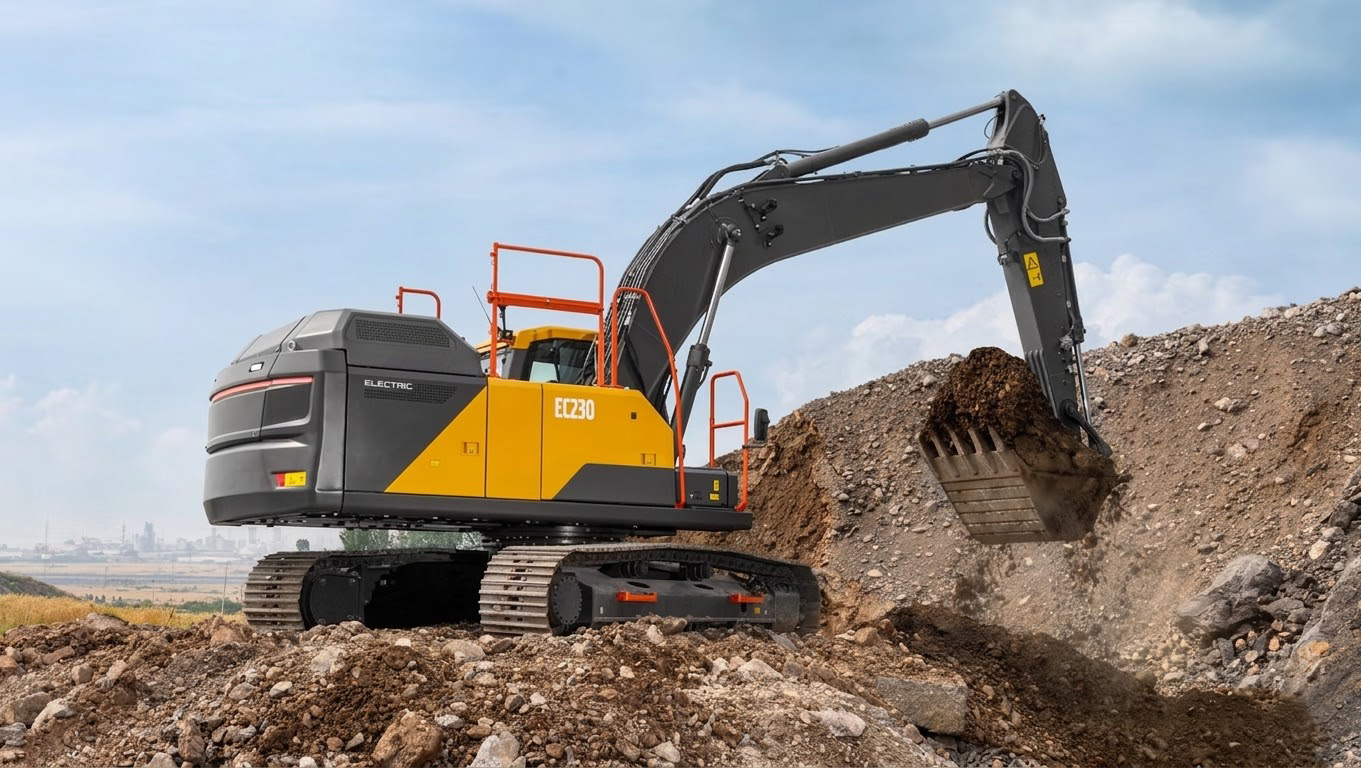
Volvo construction equipment in the EC (crawler excavators), EW (wheeled excavators), and L (wheel loaders) series is equipped with a DPF (Diesel Particulate Filter) exhaust aftertreatment system. On the one hand, it allows the machines to comply with US EPA Tier 4 / EU Stage V environmental standards; on the other, it often becomes a source of recurring faults and equipment downtime. In this article, we’ll break down how the DPF system works on Volvo construction machinery, which problems occur most frequently, and which solutions actually work in real-world operation.
## **How the DPF System Works on Volvo Construction Equipment**
A DPF, or Diesel Particulate Filter, is a type of diesel particulate filter that is made of ceramic and has a honeycomb-type pattern that traps and holds particulate soot created by diesel engines.
For Volvo EC and EW L machines, the DOC (Diesel Oxidation Catalyst) and the DPF integrated into a single housing, which works in conjunction with:
- exhaust gas temperature sensors
- a differential pressure sensor
- active and passive regeneration systems
- the engine control unit (ECU)
The more soot that builds up, the more the DPF has to do regeneration, which is the burning off of deposits at high levels of temperature. DPF regeneration can be:
- Passive: Occurs automatically at high exhaust temperatures during intensive machine operation.
- Active: The system adds more fuel to raise the temperature to about 600°C in order to burn off the soot.
- Forced: Initiated by the operator or via Volvo Tech Tool (PTT) while the machine is stationary.
On Volvo CE equipment, regeneration often requires stable engine speed and minimal load variation. On EC and EW excavators, this can be more difficult due to cyclical operation (digging–pause), while on L-series loaders it is easier during long transport cycles. However, this is exactly where the main problems begin.
### **Common DPF Problems on Volvo EC, EW, and L**
#### **1\. DPF Clogging Under Low-Load Operation**
Construction equipment frequently operates:
- at idle
- in short cycles
- at low engine speeds
The most common complaint from owners is frequent regeneration requests or the “DPF full” warning. As a result, soot accumulates, leading to:
- reduced engine power
- increased fuel consumption
- DPF / Check Engine faults
- engine derate or limp mode
#### **2\. Constantly Incomplete Regenerations**
On Volvo EC and EW excavators, regeneration is often interrupted:
- due to engine shutdown
- because of jobsite operating conditions
- when manually blocked by the operator
On models such as the EC250/EC300 and EW180, this is caused by interrupted duty cycles: the machine works in short intervals, and the exhaust does not heat up sufficiently. Under these conditions, regeneration cannot complete, soot continues to build up, and the filter clogs quickly. This leads to accelerated DPF wear and the need for forced cleaning.
#### **3\. DPF Sensor Failures**
The most vulnerable components are:
- the differential pressure sensor
- temperature sensors before and after the filter
Due to dust, vibration, and high temperatures, sensors may provide incorrect readings, triggering false faults and blocking regeneration.
#### **4\. Costly Cleaning or Filter Replacement**
Over time, the DPF fills not only with soot but also with ash, which cannot be burned off. This results in:
- the need for DPF removal
- chemical or thermal cleaning
- complete DPF replacement (very expensive)
#### **5\. EGR and AdBlue-Related Issues**
If the EGR system breaks down, it will begin to produce more soot that clogs the DPF. On machines equipped with SCR, poor-quality urea (AdBlue) can cause crystallization and indirectly affect DPF operation. Service centers and user forums note that in cold climates or quarry environments (e.g., L120, EW180 models), DPF clogging occurs more rapidly.
### **Effective Solutions to DPF Problems on Volvo Equipment**
#### **Preventive Measures**
- Use only high-quality low-ash fuel and engine oil (Volvo VDS-4.5).
- Aim to keep running the engine at higher speeds for over 30-40 minutes so passive regeneration can take place.
- Perform regular maintenance: inspect sensors and pressure lines for contamination.
#### **Regular Forced Regeneration**
Use the Volvo PTT diagnostic tool to initiate forced regeneration. Please allow 30 to 60 minutes for the process to be completed. The machine must be parked in a safe area with good ventilation.
This approach is suitable only when:
- sensors are functioning correctly
- operating conditions are appropriate
- clogging levels are still moderate
It does not fully solve the problem but helps postpone major repairs.
#### **Diagnostics and Professional DPF Cleaning**
For diagnostics and fault code reading, you can use any convenient solution such as the Mochester 4 App (M4 App), Volvo PTT, or similar tools.
Professional DPF cleaning (ultrasonic or thermal) is an alternative to replacement.
Pros:
- good temporary restoration of flow capacity
- significantly cheaper than replacement
Cons:
- does not completely remove ash
- limited service life of the result
Replace faulty sensors (differential pressure, temperature) as required.
#### **Software-Based DPF Deactivation**
In practice, this is one of the most reliable solutions for machines operating off public roads — in quarries, on construction sites, or in forestry.
Advantages:
- stable engine operation
- no derate or limp modes
- reduced fuel consumption
- no downtime due to regeneration cycles
For Volvo EC, EW, and L machines, it is critical that deactivation is performed correctly at the firmware level, with proper ECU reprogramming while preserving engine logic. In addition, physical removal of the DPF is required. We strongly recommend entrusting this set of procedures to experienced professionals.
### **What Volvo Equipment Owners Should Keep in Mind**
- DPF systems are highly sensitive to operating modes and fuel quality
- DPF-related faults almost always lead to reduced productivity
- frequent regenerations accelerate wear of the turbocharger and exhaust system
- poorly implemented sensor “emulators” often cause new fault codes
### **Conclusion**
The DPF system on Volvo EC, EW, and L construction equipment is an effective emissions-reduction solution, but at the same time it is one of the most problematic components due to its sensitivity to operating conditions. At construction sites and quarries, DPF systems work outside of optimal parameters, which causes clogging, faults, and downtime.
For short-term relief, timely regeneration, professional cleaning, and high-quality consumables can help. However, for long-term stable operation, many owners ultimately choose professional software solutions tailored to the real-world operating conditions of their equipment.
## Sources
- [EW160E, EW180E Operator’s Manual](https://www.dumarent.be/fpdf/000105_pdf_A4.php?depdf=VOLVO+EW160E_EN.pdf&soortdoc=HL) — PUB 20052711-C, March 2019, EW160E and EW180E SN 322001–322999, printed pp. 7–8, 31–32, 165–175, 327
- [EC140E Operator’s Manual](https://irp.cdn-website.com/28d45882/files/uploaded/EC140EL%20O.pdf) — PUB 20044621-F, March 2021, EC140E L/EC140E LM, printed pp. 10–11, 184–195, 354
- [Volvo Excavators: EC250D, EC300D](https://cowin.com/wp-content/uploads/2015/06/ProductBrochure_EC250D_EC300D_EN_22_20027100-B_2012.05-1.pdf) — Ref. No. 20027100-B, English-22, May 2012, D8H Tier 4 Interim / Stage IIIB, p. 10
- [Volvo Wheel Loaders: L120H](https://www.volvoce.com/-/media/aprimo/pdf/large-wheel-loaders/l120h/product-guide-l120h-stv-en-21-20062970-d.pdf) — Ref. No. 20062970\_D, English-21, January 2026, D8M Stage V, pp. 3–4
- [Effect of regeneration method and ash deposition on diesel particulate filter performance: a review](https://pubmed.ncbi.nlm.nih.gov/36820972/) — 2023, 30(16), pp. 45607–45642, DOI 10.1007/s11356-023-25880-2
- [Diesel particulate filter regeneration mechanism of modern automobile engines and methods of reducing PM emissions: a review](https://pmc.ncbi.nlm.nih.gov/articles/PMC9905014/) — 2023, 30(14), pp. 39338–39376, DOI 10.1007/s11356-023-25579-4
- [What general actions does this regulation prohibit?](https://www.ecfr.gov/current/title-40/chapter-I/subchapter-U/part-1068/subpart-B/section-1068.101) — 40 CFR § 1068.101(b)(1)
Sources last checked: 2026-09-04
[Use Cases](https://volvodpfdelete.com/use-cases/)
## Related reading
[All articles](https://volvodpfdelete.com/search/)

Use Cases
### [Tuning and DPF/SCR Removal on Volvo Penta Engines for Boats and Yachts]()
Why Volvo Penta owners remove DPF and SCR, what proper marine ECU tuning delivers, and when these upgrades are truly justified.
Read guide
Use Cases
### [Volvo Excavator DPF Delete: Is It Worth Removing the DPF from Your Excavator?]()
While Volvo excavators are equipped with DPF systems to attempt to curb emissions, the systems can pose operational issues, including fuel consumption, operational downtime, and issues with system regeneration. This article discusses the Diesel Particulate Filter system on Volvo excavators including the EC210, EC220 and EC300, including what occurs if the system is bypassed. The article discusses the DPF delete procedure, the plausibility of improved performance and fuel consumption, and the implications in terms of warranty and legality.
Read guide
Use Cases
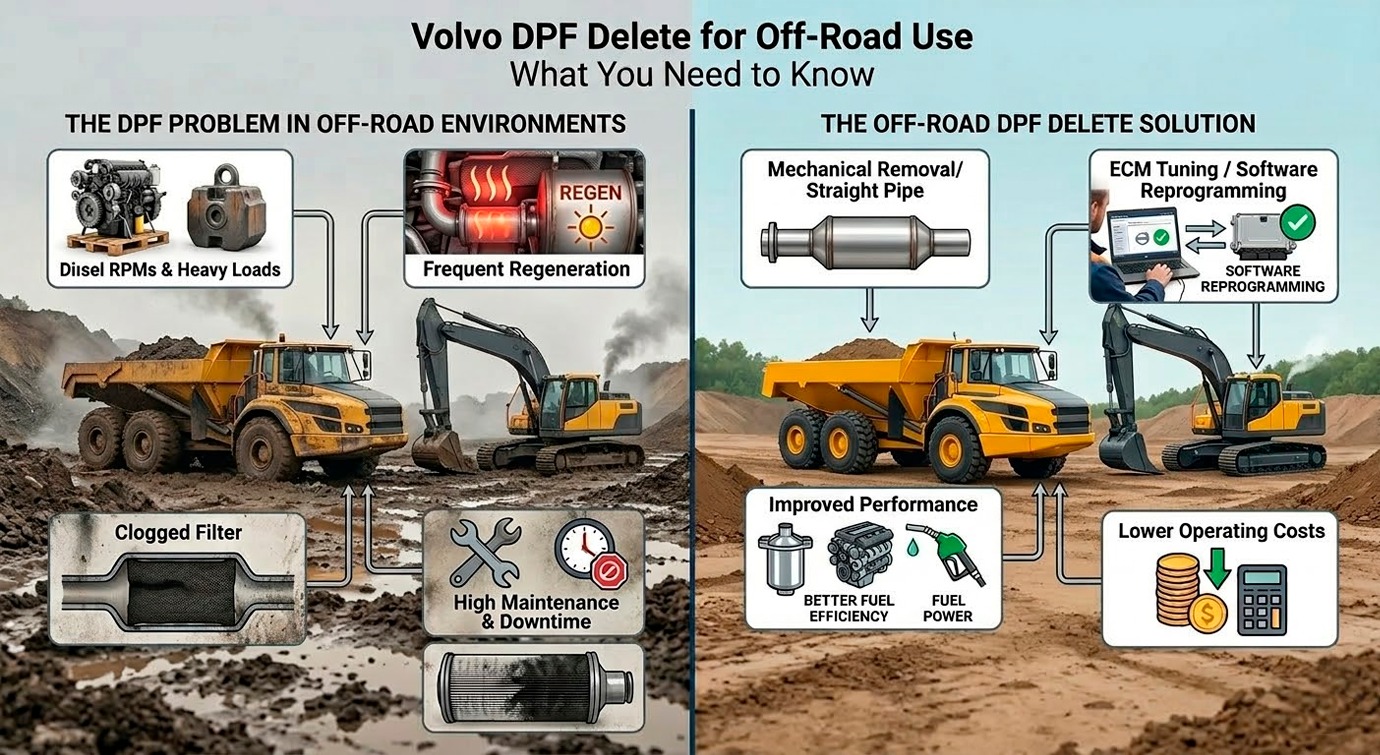
### [Volvo DPF Delete for Off-Road Use: What You Need to Know]()
Volvo trucks and construction equipment can show DPF warnings when regeneration keeps getting interrupted. This guide explains soot and ash buildup, what a DPF delete changes, and what to check before deciding how to address recurring problems.
Read guide
[Explore all articles](https://volvodpfdelete.com/search/)