# Forced DPF Regeneration on Volvo Equipment: When It’s Needed and How to Do It Properly
Canonical: https://volvodpfdelete.com/tech-guides/volvo-forced-dpf-regeneration/
Content type: service-guide
Author: David Nelson
Published: 2026-08-01T00:00:00.000Z
Modified: 2026-11-02T07:06:04.537Z
Category: Tech Guides
Brand: Volvo
Vehicle type: truck, construction-equipment
Systems: DPF, DOC, EGT, ECU
Intent: maintenance
Generated at: 2026-11-19T10:14:14.973Z
> Learn when forced DPF regeneration is needed on Volvo trucks and equipment, how to perform it safely, and what mistakes to avoid to prevent costly repairs.
Volvo
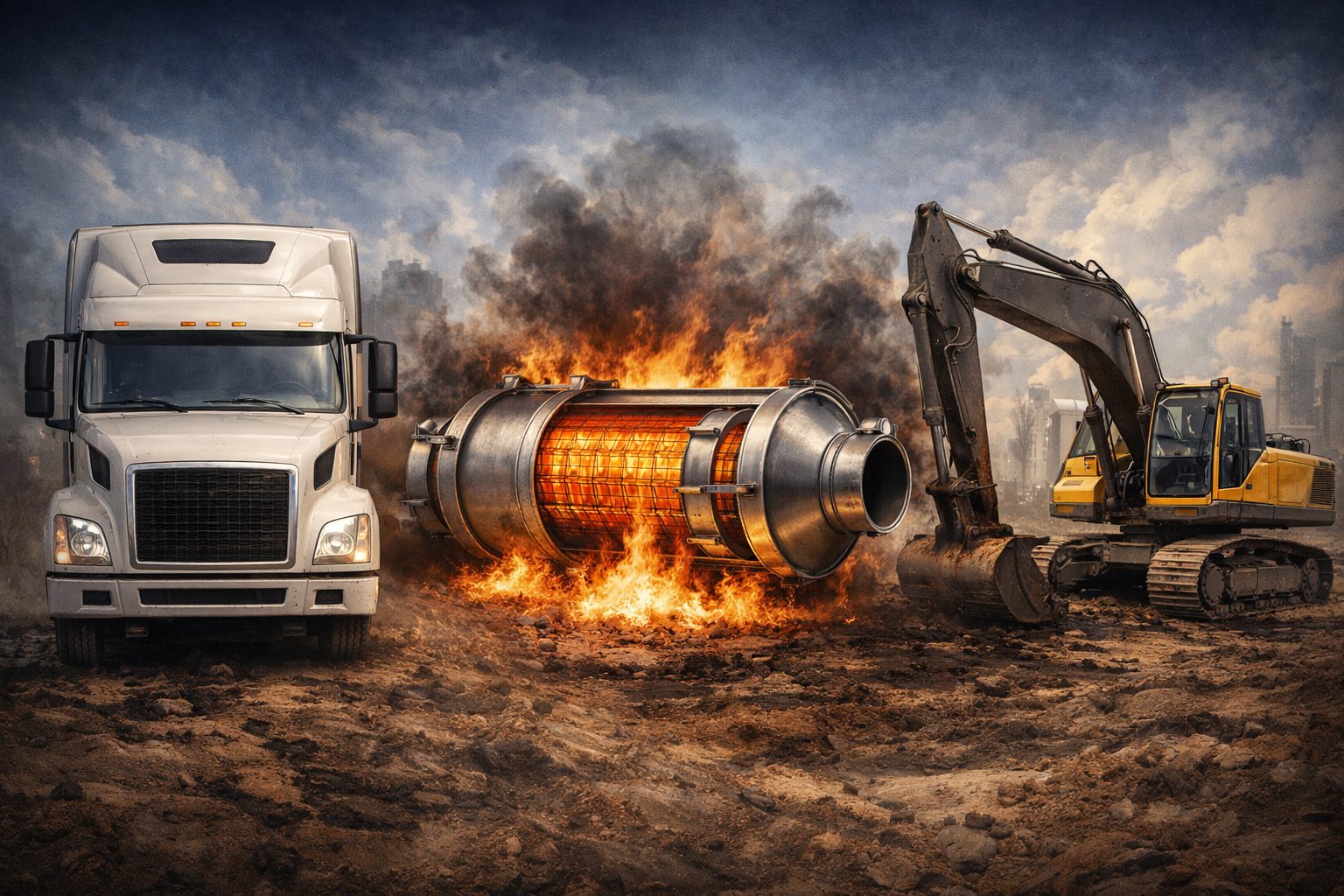
The Diesel Particulate Filter (DPF) is a key component of the emissions system on modern Volvo trucks and construction equipment. This helps the equipment meet EPA, Euro, and other environmental standards by capturing soot particles and lowering harmful emissions. Eventually, though, the DPF becomes jammed with soot and needs cleaning through the process of regeneration. In most cases, the system performs this process automatically — but sometimes a forced DPF regeneration is required.
In this article, we’ll explain when forced regeneration is truly necessary, how to perform it correctly, and which mistakes can lead to costly repairs.
## **What is the DPF and why is Regeneration Needed?**
A DPF is an exhaust filter that removes the soot contained in diesel exhaust. Soot accumulates and the filter is less efficient which triggers problems in the engine, like power loss and the limp mode activating.
Regeneration happens when soot built up is burned at high enough temperatures that it turns into ash. There are three types of regeneration:
- **Passive Regeneration:** Happens by itself while driving on the highway when temperatures in the exhaust are on the higher end (482-662°F / 250-350°C).
- **Active Regeneration:** Initiated by the ECU when soot levels rise, injecting additional fuel to raise temperatures to 1022–1112°F (550–600°C).
- **Forced Regeneration:** When automatic modes do not work, a technician must use diagnostic tools, or service software/system to help resolve the issues that the automatic modes failed to resolve. Temperatures may reach 1112–1472°F (600–800°C).
On Volvo machines, regeneration typically takes 20–60 minutes and requires several conditions, such as a full AdBlue tank (for Euro-6 engines) and the absence of critical fault codes.
### **When Forced DPF Regeneration is Necessary For Volvo Equipment?**
The forced regeneration is performed when:
#### **1\. Automatic regeneration does not initiate or has a interruption**
Common reasons include:
- short-distance driving,
- extended idling,
- low-speed operation on construction sites.
#### **2\. Soot levels reach a critical point**
When the DPF gets extremely clogged, the dashboard may show the following:
- DPF Full
- Soot Level High
- Engine Derate
- Exhaust system fault codes (e.g., P2463, P242F, or Volvo Tech Tool equivalents)
#### **3\. The regeneration system is malfunctioning**
This may be caused by:
- faulty pressure sensors,
- inaccurate temperature readings,
- issues with the diesel dosing module,
- ECU faults.
#### **4\. The equipment enters derate mode**
In this mode, the engine limits power to protect the DPF — a serious problem for trucks and heavy machinery.
### **Signs of a Clogged DPF**
- DPF warning light on the dashboard
- Increased fuel consumption
- Power loss, high idle RPM (around 1000 rpm)
- Change in exhaust smell or visible vapor
- Differential pressure above 30 kPa (checked via a scanner)
- OBD messages indicating high soot mass
### **How to Perform a Forced DPF Regeneration on a Volvo**
Although you are working with Volvo Trucks, Volvo Construction Equipment, or Volvo Penta engines, the overall workflow will be the same, but the steps will be a bit different.
#### **Step 1: Perform diagnostics**
Before starting regeneration, make sure:
- all sensors are functioning properly,
- soot levels are truly high,
- no fault codes are blocking regeneration.
#### **Step 2: Confirm that all regeneration conditions are met**
Typically required:
- engine temperature of at least 140–160°F (60–70°C),
- fuel level above 25–30%,
- operation outdoors,
- no flammable materials nearby.
#### **Step 3: Start forced regeneration using diagnostic software**
The process takes 20–60 minutes.
DPF temperatures rise to 1112–1200°F (600–650°C), and soot levels gradually decrease.
#### **Step 4: Verify the results**
After completion:
- check that differential pressure is within spec,
- confirm no residual fault codes,
- perform a test drive.
### **Common Mistakes During Forced Regeneration**
**1\. Performing regeneration without diagnostics
**If a temperature or pressure sensor is faulty, a forced regens will likely fail and/or further exacerbate the issue at hand.
**2\. Running regeneration too frequently
**Excessive regens accelerate DPF wear.
**3\. Ignoring the root cause of clogging
**DPF clogging is often a symptom of:
- EGR malfunctions,
- high oil consumption,
- improper fuel injection,
- low-quality diesel.
If you only remove the soot but not the cause, the issue will return.
### **Safety Tips and Warnings**
- **Safety:** Avoid direct contact with the exhaust — temperatures may exceed 932°F (500°C). Do not perform regeneration indoors.
- **Frequency:** City driving requires more frequent recharges (every 60-250 miles). Highway driving requires fewer.
- **Troubleshooting:** If regeneration is not successful, the EGR system, sensors, and pressure tubes should be checked.
- **Tools:** Use an OBD scanner to monitor soot mass and differential pressure.
- **Prevention:** Drive at higher speeds periodically and use high-quality fuel.
If issues persist, contact an authorized Volvo service center — improper handling can damage the system.
### **When Forced Regeneration Won’t Help**
Forced regeneration is ineffective if:
- the filter is clogged with ash rather than soot (ash cannot burn),
- the DPF is cracked or damaged,
- the engine has major mechanical issues,
- exhaust sensors are providing incorrect data.
In such cases, you may need:
- professional DPF cleaning,
- repair or replacement of the filter,
- software or hardware repair of the emissions system.
### **How to Extend DPF Life on Volvo Equipment**
- Use high-quality fuel
- Maintain proper combustion
- Perform regular diagnostics
- Avoid shutting off the engine immediately after heavy load
- Avoid long periods of idling
- Monitor oil consumption — burning oil quickly fills the DPF with ash
### **Conclusion**
On a Volvo truck or pieces of construction equipment, performing forced DPF regeneration is a good way to improve performance — provided, of course, that it's done properly. This prevents expensive breakdowns of the DPF and repairs over the lifespan of the DPF and the machine as well as minimizing costly standstills.
The key is not to rely on forced regeneration as a universal solution. If the system requires frequent regens, the root cause must be identified and eliminated.
## Sources
- [EC140E Operator’s Manual](https://irp.cdn-website.com/28d45882/files/uploaded/EC140EL%20O.pdf) — PUB 20044621-F, March 2021, EC140E L/EC140E LM, printed pp. 184–195 (PDF pp. 186–197)
- [Exhaust Aftertreatment System Fault Tracing - D11F, D13F and D16F](https://hhrvresource.com/VolvoDocsGenII/Volvo%20Engine%20Manuals/D13/Exhaust%20Aftertreatment%20System%20Fault%20Tracing.pdf) — Group 258, No. 45, PV776-20143790, March 2008, pp. 2–5
- [Regeneration control for DPF](https://stpi.it.volvo.com/STPIFiles/Volvo/FactSheet/DRC-AMII_Eng_03_338853982.pdf) — DRC-AMII, ENG Version 03, February 26, 2024, p. 1
- [Body Builder Instructions: Engine, General Information](https://www.volvotrucks.us/media/vtna/files/shared/body-builder/manuals/2026/volvo-section-2-engine-approved.pdf) — VN(4), Section 2, USA191926741, November 2025, pp. 11–12
- [Remote Diagnostics Repair Instructions](https://static.nhtsa.gov/odi/tsbs/2025/MC-11012149-0001.pdf) — Volvo RD24-30, December 17, 2024, P2463-00, US24 Emissions VN(4) B1, English p. 1
- [Diagnostic Trouble Codes (DTC) P208064, P208464, P242B64 and P246F64 Lighting The Malfunction Indicator Lamp (MIL) - US17+OBD19 And Newer Emissions, Model Years 2020 and Newer](https://static.nhtsa.gov/odi/tsbs/2021/MC-10201705-0001.pdf) — Fault Tracing Procedure, PTT operation 2589-08-03-02
- [Diesel particulate filter regeneration mechanism of modern automobile engines and methods of reducing PM emissions: a review](https://pmc.ncbi.nlm.nih.gov/articles/PMC9905014/) — 2023, 30(14), pp. 39338–39376, DOI 10.1007/s11356-023-25579-4
- [Effect of regeneration method and ash deposition on diesel particulate filter performance: a review](https://pubmed.ncbi.nlm.nih.gov/36820972/) — 2023, 30(16), pp. 45607–45642, DOI 10.1007/s11356-023-25880-2
Sources last checked: 2026-09-07
[Tech Guides](https://volvodpfdelete.com/tech-guides/)
## Related reading
[All articles](https://volvodpfdelete.com/search/)

Tech Guides/D13
### [Volvo P24A0 and P249F: Low-Temperature DPF Regeneration Diagnosis]()
Volvo D13 codes P24A0 and P249F point to problems with regeneration temperature control. Learn how to verify the fault in Premium Tech Tool and check the 7th injector, DOC, and exhaust temperature sensors before replacing parts.
Read guide

Tech Guides/D13
### [Anatomy of the Volvo D13: Why This Diesel Became an Industry Standard]()
What made the Volvo D13 a familiar engine in heavy-duty trucking? This overview covers its specifications, horsepower, low-RPM torque, fuel economy, reliability, and common problem areas. It also explains why engine generation, maintenance history, and the truck’s supporting systems matter when evaluating a D13.
Read guide
Tech Guides/D13
### [Volvo D13 DPF Differential Pressure Sensor Diagnostics: High Delta P vs. Blocked Tubes]()
Learn how to check the Volvo D13 DPF differential pressure sensor, tubes, and fittings, and use PTT live data to determine whether the filter is restricted.
Read guide
[Explore all articles](https://volvodpfdelete.com/search/)