# Cleaning the DPF on Volvo Trucks and Construction Equipment: Chemical vs. Ultrasonic — Which Is More Effective?
Canonical: https://volvodpfdelete.com/tech-guides/volvo-dpf-cleaning-chemical-vs-ultrasonic/
Content type: technical-comparison
Author: Jason Reed
Published: 2026-05-18T00:00:00.000Z
Modified: 2026-09-14T07:06:00.000Z
Category: Tech Guides
Brand: Volvo
Vehicle type: truck, construction-equipment
Systems: DPF, soot, ash
Intent: maintenance-comparison
Generated at: 2026-11-19T10:14:14.973Z
> Compare chemical and ultrasonic DPF cleaning for Volvo trucks and construction equipment. Learn what each method does and how to verify the results.
Volvo
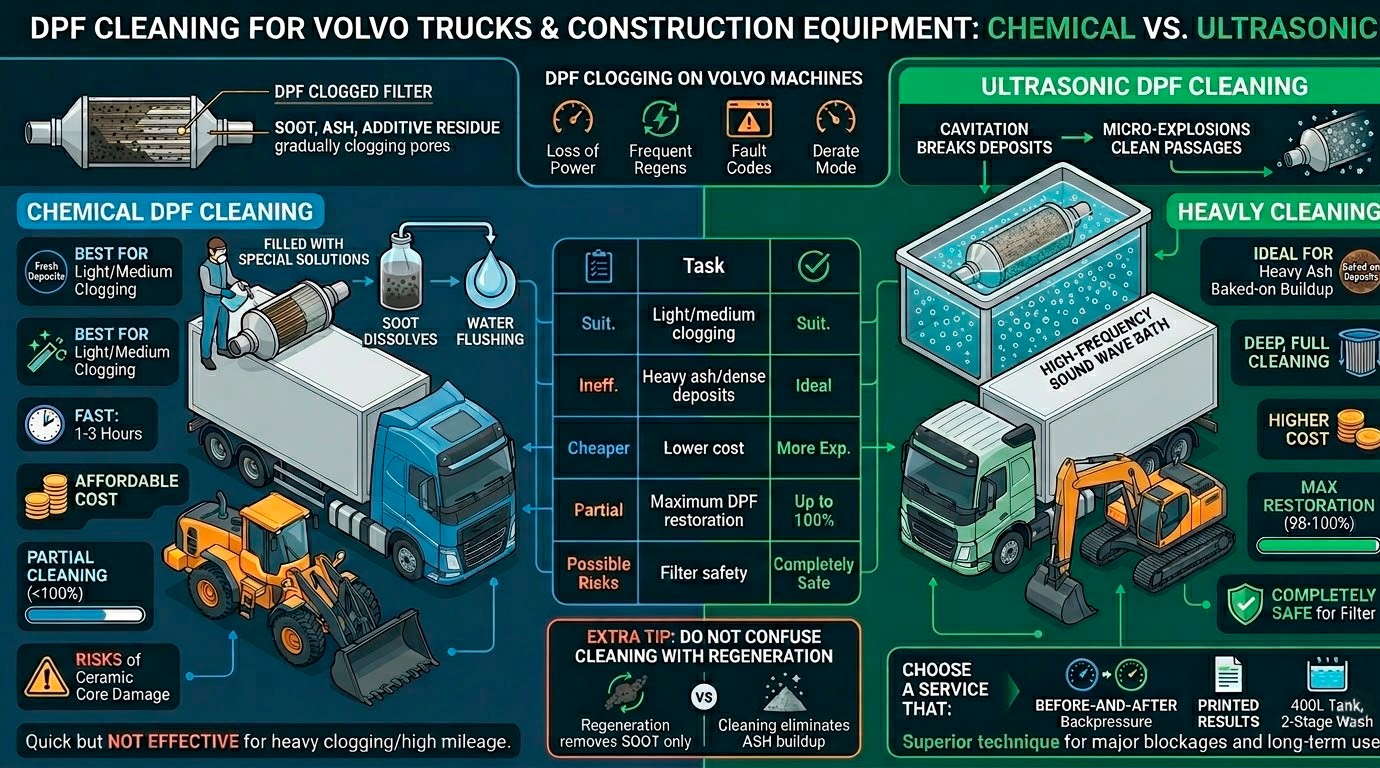
The Diesel Particulate Filter (DPF) is a key component of the emissions system—and at the same time, one of the most expensive and problematic parts found in modern Volvo trucks and construction equipment. When it becomes clogged, power drops, fuel consumption increases, turbo boost pressure faults appear, and the machine goes into derate mode.
For cleaning machine attachment filters, Volvo equipment owners usually use either and one of the following methods: ultrasonic cleaning and chemical cleaning. We will take an in-depth look at how each of the methods works, when each one works best, and which is the most suitable option for your circumstances.
## **How a Volvo DPF Gets Clogged**
Volvo trucks and heavy equipment use wall-flow filters made of silicon carbide (SiC) or cordierite. Soot, ash from oil, and additive residue gradually clog the pores and channels.
### **Main causes of accelerated clogging:**
- frequent idling (construction sites, traffic);
- poor-quality fuel or oil with high sulfur and ash content;
- disabled or malfunctioning regeneration system (7th injector, pressure sensors);
- short trips that prevent proper active regeneration.
### **Cleaning is required if you notice:**
- loss of power and slow acceleration;
- frequent DPF regenerations;
- differential pressure sensor faults;
- increased fuel consumption;
- derate mode or power limitation;
- frequent interruptions of automatic regeneration.
If the filter isn’t physically damaged, it can be restored by 95–98% — the key is choosing the right cleaning method.
### **Chemical DPF Cleaning: Features and Effectiveness**
#### **How the method works**
Chemical cleaning involves using special solutions that dissolve soot and ash deposits inside the filter channels. The filter is filled with a chemical agent and then flushed with water or rinsed under pressure.
#### **Advantages**
- Suitable for moderate clogging.
- Effective on soft or fresh deposits.
- Fast procedure — 1 to 3 hours.
- More affordable.
#### **Disadvantages**
- May not remove dense ash or baked-on deposits.
- Aggressive chemicals can potentially damage the ceramic core.
- Often cleans only part of the channels — effectiveness is below 100%.
**Bottom line:** Although quick and effective, chemical cleaning is not effective for heavily clogged Volvo DFPs, especially for high mileage units or machines that are constantly under severe loads.
### **Ultrasonic DPF Cleaning: Maximum Restoration**
#### **How the technology works**
Ultrasonic cleaning uses high-frequency sound waves in a water solution. These waves create microscopic cavitation bubbles—micro-explosions—that break loose deposits even in the narrowest passages of the DPF.
##### **Advantages**
- Deep, full cleaning of the entire filter structure.
- Removes dense ash that chemicals cannot dissolve.
- Restores flow capacity to 98–100%.
- Completely safe for the ceramic substrate.
- Ideal for Volvo equipment after long-term use, dusty environments, hilly terrain, or low-temperature cycles.
##### **Disadvantages**
- Higher cost compared to chemical cleaning.
- Requires specialized equipment.
**Bottom line:** When it comes to cleaning issues such as big blockages or missing pressure faults, the best technique to use to clean Volvo FH, FM and FE FL trucks and Volvo CE construction equipment is ultrasonic cleaning.
### **Which Is Better for Your Volvo DPF: Chemical or Ultrasonic Cleaning?**
| **Task** | **Chemical Cleaning** | **Ultrasonic Cleaning** |
| --- | --- | --- |
| Light/medium clogging | Suitable | Suitable |
| Heavy ash buildup, dense deposits | Ineffective | Ideal |
| Lower cost | Cheaper | More expensive |
| Maximum DPF restoration | Partial | Up to 100% |
| Filter safety | Possible risks | Completely safe |
### **Extra Tip: Don’t Confuse Cleaning With Regeneration**
Volvo vehicles with the DPF can use forced regeneration through the ECU. However, while regeneration removes soot, regeneration does nothing to eliminate the remaining ash. Even if diagnostics show a “successful regeneration,” the filter may still be 70–90% clogged with ash.
That’s why periodic cleaning (every 200,000–300,000 km) is recommended — ideally with ultrasonic technology, especially for equipment operating in severe conditions.
### **Personal Recommendation: Choose a Service That**
- Performs before-and-after backpressure measurements on a test bench;
- Provides printed results “before” and “after”;
- Uses a tank of at least 400 liters with a two-stage wash (alkali + neutralizer).
### **Conclusion**
Chemical cleaning is a fast, budget-friendly way to remove some deposits. Ultrasonic cleaning is the best of all performing methods, and is also the most effective in restoring the DPF and extending its service life.
For Volvo trucks and construction equipment—especially high-mileage units or machines operating under heavy load—the optimal choice is ultrasonic cleaning. It ensures stable engine performance and minimizes risks to the filter.
## Sources
- [Evaluation of the Effectiveness of Diesel Particulate Filter Cleaning Methods and their Effect on Fuel Consumption](https://saemobilus.sae.org/papers/evaluation-effectiveness-diesel-particulate-filter-cleaning-methods-effect-fuel-consumption-2023-01-0376) — SAE 2023-01-0376, 2023, Abstract
- [Diesel Particulate Filter Cleaning Effectiveness: Estimated Ash Loading, Quantified Particulate Removal, and Post-cleaning Filter Pressure Drop](https://link.springer.com/article/10.1007/s40825-019-00149-8) — Published online November 12, 2019. Emission Control Science and Technology 6 (2020), pp. 75–85
- [Pressure Drop and Cleaning of In-Use Ash Loaded Diesel Particulate Filters](https://saemobilus.sae.org/papers/pressure-drop-cleaning-use-ash-loaded-diesel-particulate-filters-2006-01-3256) — SAE 2006-01-3256, 2006, Abstract
- [All About Diesel Particulate Filters](https://www.walker-eu.com/files/7513/9634/1418/W145_Walker_All_About_DPF_A5_31.pdf) — Comments on DPF Cleaning Solutions, pp. 12–13
- [Diesel Particulate Filter Operation and Maintenance](https://www.epa.gov/sites/default/files/2016-03/documents/420f10027.pdf) — EPA-420-F-10-027, May 2010, pp. 1–2
- [The origin, transport, and evolution of ash in engine particulate filters](https://www.ornl.gov/publications/the-origin-transport-and-evolution-of-ash-in-engine-particulate-filters/) — Applied Energy 263 (2020), article 114631. DOI 10.1016/j.apenergy.2020.114631
- [Body Builder Instructions — Engine, General Information](https://www.volvotrucks.us/media/vtna/files/shared/body-builder/manuals/2026/volvo-section-2-engine-approved.pdf) — VN(4), Section 2, USA191926741, November 2025, pp. 11–12
- [Service at a Glance Maintenance Intervals](https://www.volvotrucks.us/media/vtna/files/saag-2022-ghg-newer-poster-011023-eng.pdf) — PV960-V-SaaG-011023, 2022 GHG and Newer, Diesel Particulate Filter (Clean)
- [Operator’s Manual — EC140E L/EC140E LM](https://irp.cdn-website.com/28d45882/files/uploaded/EC140EL%20O.pdf) — PUB 20044621-F, March 2021, Lubrication and service chart, p. 296
Sources last checked: 2026-09-14
[Tech Guides](https://volvodpfdelete.com/tech-guides/)
## Related reading
[All articles](https://volvodpfdelete.com/search/)

Tech Guides/D13
### [Volvo P24A0 and P249F: Low-Temperature DPF Regeneration Diagnosis]()
Volvo D13 codes P24A0 and P249F point to problems with regeneration temperature control. Learn how to verify the fault in Premium Tech Tool and check the 7th injector, DOC, and exhaust temperature sensors before replacing parts.
Read guide

Tech Guides/D13
### [Anatomy of the Volvo D13: Why This Diesel Became an Industry Standard]()
What made the Volvo D13 a familiar engine in heavy-duty trucking? This overview covers its specifications, horsepower, low-RPM torque, fuel economy, reliability, and common problem areas. It also explains why engine generation, maintenance history, and the truck’s supporting systems matter when evaluating a D13.
Read guide

Tech Guides/D13
### [Volvo D13 DPF Differential Pressure Sensor Diagnostics: High Delta P vs. Blocked Tubes]()
Learn how to check the Volvo D13 DPF differential pressure sensor, tubes, and fittings, and use PTT live data to determine whether the filter is restricted.
Read guide
[Explore all articles](https://volvodpfdelete.com/search/)