# Why Volvo D13 DPF Regeneration Fails or Does Not Complete
Canonical: https://volvodpfdelete.com/tech-guides/volvo-d13-dpf-regeneration-fails/
Content type: diagnostic-guide
Author: David Nelson
Published: 2026-03-01T00:00:00.000Z
Modified: 2026-05-08T07:06:00.000Z
Category: Tech Guides
Brand: Volvo
Engine: D13
Vehicle type: truck
Systems: DPF, DOC, HC doser, EGT, differential pressure
Intent: troubleshooting
Generated at: 2026-11-19T10:14:14.973Z
> Volvo D13 regen won't start, stops early, or happens too often? Learn what to check before forcing another regen or replacing the DPF.
Volvo/ D13
## **Why is my Volvo D13 DPF regeneration not working?**
A Volvo D13 regeneration can fail because the engine cannot reach the required exhaust temperature, an aftertreatment sensor is reporting incorrect data, fuel dosing is not working correctly, the DPF is excessively restricted, or another active fault is preventing regeneration. A parked regen may also be blocked because one or more regeneration criteria have not been met.
## **Why does my Volvo D13 start regeneration but then stop?**
If a regen starts and then stops, the ECM may be detecting insufficient temperature, abnormal exhaust pressure, a sensor problem, a dosing fault, or another condition that makes continued regeneration unsafe or ineffective. The important step is to determine _why_ the regeneration was interrupted rather than repeatedly commanding another regen.
## **Volvo D13 Regen Problems: Start With the Symptom**
A DPF regeneration is not simply an ON/OFF function. The Volvo D13 engine and aftertreatment system continuously monitor temperature, pressure, exhaust flow, soot loading and other operating conditions to determine whether regeneration can start and whether it can continue.
That is why **Volvo D13 regen problems** can appear in several different ways:
- Regeneration does not start.
- The truck will not perform a parked regeneration.
- Regeneration starts but stops before completion.
- The DPF warning returns shortly after a successful regen.
- Regeneration happens much more frequently than normal.
- DPF soot level continues to increase despite repeated regeneration attempts.
Volvo's diagnostic documentation identifies faults associated with excessive regeneration frequency, excessive soot accumulation, low regeneration temperature and excessive time entering closed-loop regeneration control.
**IMPORTANT:** Do not treat a failed regeneration as proof that the DPF itself is bad. The DPF is often the component showing the symptom rather than the original cause.
### **1\. Regeneration Does Not Start**
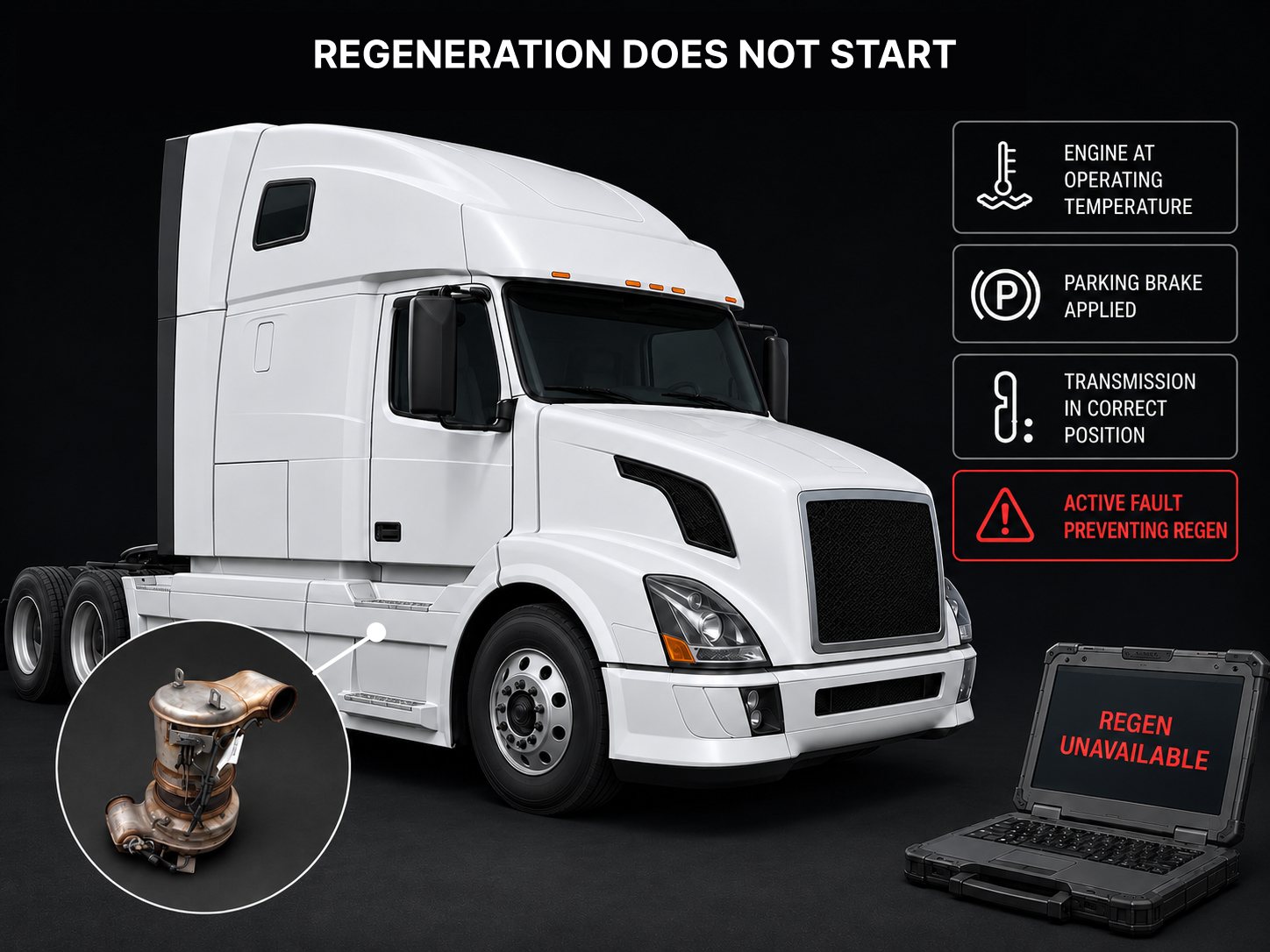
One of the most common complaints is: **“My Volvo D13 will not do parked regen.”**
The driver selects parked regeneration, but nothing happens, or the system reports that regeneration is unavailable.
#### **Why Volvo D13 parked regen may not work**
A parked regeneration requires certain operating conditions. Depending on the truck configuration and software version, these can include:
- Engine at operating temperature.
- Vehicle stationary.
- Parking brake applied.
- Transmission in the required position.
- Accelerator released.
- Clutch released where applicable.
- Regeneration enabled.
- No active fault preventing regeneration.
- Soot level within the allowable range for the requested regeneration.
- Other system-specific criteria satisfied.
Volvo documentation specifically describes regeneration criteria and notes that a regeneration request can be unavailable when those criteria are not met.
#### **What to check first**
If the **Volvo D13 parked regen is not working**, do not immediately replace the DPF.
Connect the appropriate diagnostic system and check:
1. Active ECM and ACM fault codes.
2. Regeneration enable/inhibit status.
3. Regeneration criteria.
4. Calculated DPF soot level.
5. Exhaust temperature sensor readings.
6. DPF differential pressure.
7. Aftertreatment fuel dosing status.
8. Engine coolant temperature.
9. Turbocharger and air-management parameters.
Volvo Premium Tech Tool is designed to diagnose, test, calibrate and program Volvo systems, making it particularly useful when a regeneration is being blocked by an electronic or system-level condition.
#### **Common causes**
A Volvo D13 regen may be inhibited by:
- Active aftertreatment DTCs.
- Excessive calculated soot loading.
- Low engine temperature.
- Faulty temperature sensors.
- Incorrect differential-pressure readings.
- DPF regeneration disabled by configuration.
- Fuel dosing problems.
- Exhaust leaks.
- Engine performance problems affecting exhaust temperature.
- Turbocharger or boost-control problems.
#### **What You Should Know**
A parked regeneration is not necessarily the correct solution when soot loading is already beyond the permitted range. At a critical soot level, the system can require service intervention rather than allowing a normal parked regeneration. Volvo documentation describes situations where critical soot levels require technician-performed service regeneration or DPF replacement.
## **2\. Regeneration Starts but Stops**
This is a different problem from a regen that never starts.
The truck begins the regeneration process, exhaust temperature rises, and then the process terminates before the DPF has been adequately regenerated.
This is the classic **Volvo D13 regen stops** or **Volvo D13 regeneration not completing** complaint.
### **Why does a Volvo D13 regen stop?**
The ECM needs to maintain the conditions necessary for controlled regeneration. Regeneration can be halted when changes in temperature, pressure or fuel dosing, or monitored parameter moves outside anticipated limits.
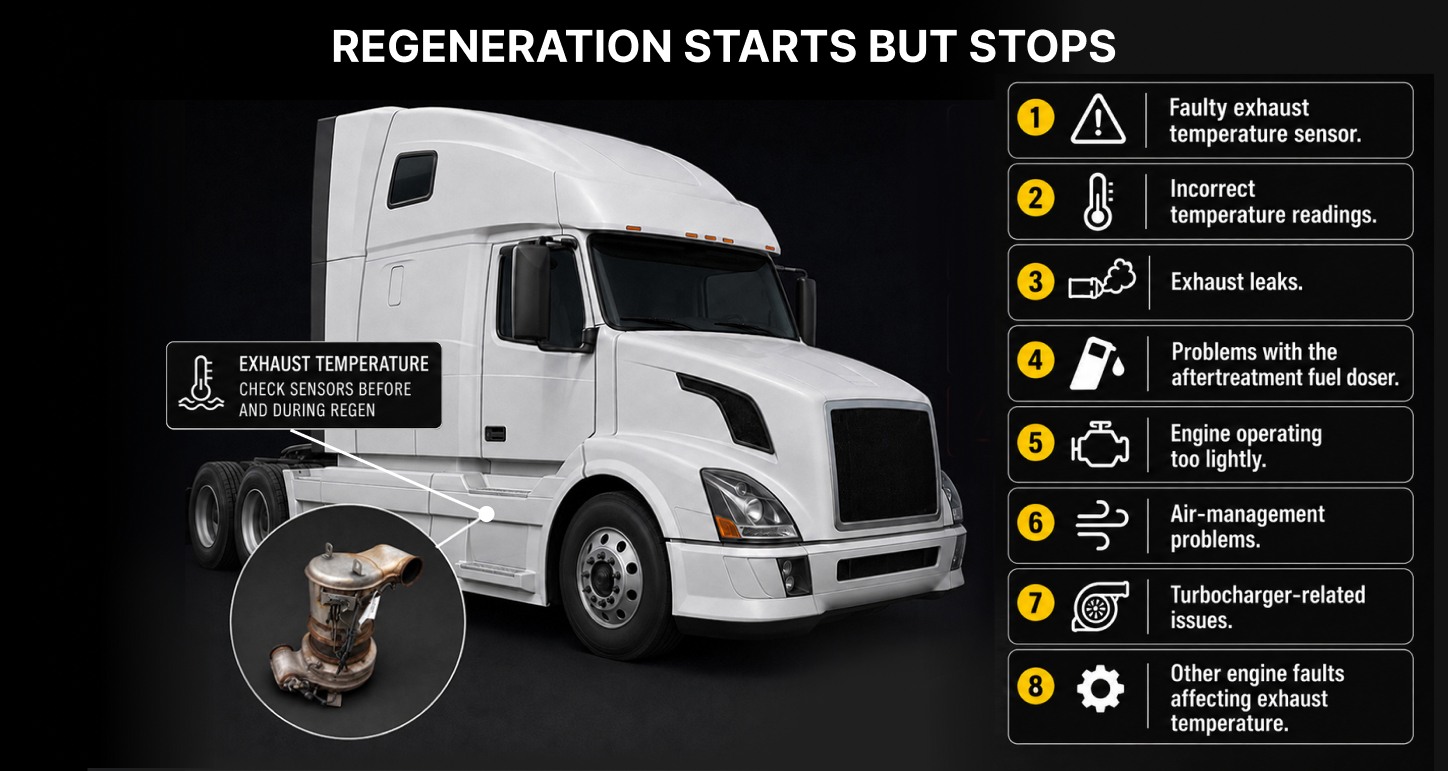
Potential causes include:
#### **Insufficient exhaust temperature**
The system is designed for soot oxidation once the DPF reaches a certain temperature. Should the system fail to reach or hold that temperature, regeneration may stop.
These symptoms might be caused by:
- Faulty exhaust temperature sensor.
- Incorrect temperature readings.
- Exhaust leaks.
- Problems with the aftertreatment fuel doser.
- Engine operating too lightly.
- Air-management problems.
- Turbocharger-related issues.
- Other engine faults affecting exhaust temperature.
Volvo fault documentation includes **P24A0 — Closed Loop DPF Regeneration Control at Limit – Temperature Too Low**, which directly illustrates how inadequate temperature can prevent successful regeneration.
#### **Incorrect DPF pressure information**
The ECM uses exhaust pressure information to evaluate DPF restriction and system operation.
A damaged, restricted or incorrectly connected pressure-sensing system can therefore cause regeneration problems.
Check:
- Differential-pressure sensor.
- Pressure tubes.
- Tube connections.
- Blockages in pressure lines.
- Wiring and connectors.
- Pressure readings at idle and under load.
#### **Fuel dosing problem**
Active regeneration requires additional heat generation. On Volvo D13 systems this involves the aftertreatment fuel dosing system.
A faulty or restricted dosing component can prevent the exhaust from reaching the temperature required for regeneration.
Volvo service documentation specifically describes troubleshooting of the aftertreatment hydrocarbon doser in connection with DPF-related faults and service regeneration.
#### **Excessive soot loading**
If the DPF is already heavily loaded, regeneration can become increasingly difficult.
This can create a cycle:
**Incomplete regen → more soot → higher restriction → more difficult regeneration → failed regen → higher soot**
At some point, another normal regeneration attempt may no longer be an appropriate repair.
**IMPORTANT:** Repeatedly commanding regeneration without identifying the cause can turn a diagnostic problem into a damaged DPF or aftertreatment component problem.
## **3\. Regeneration Completes but the Warning Returns**
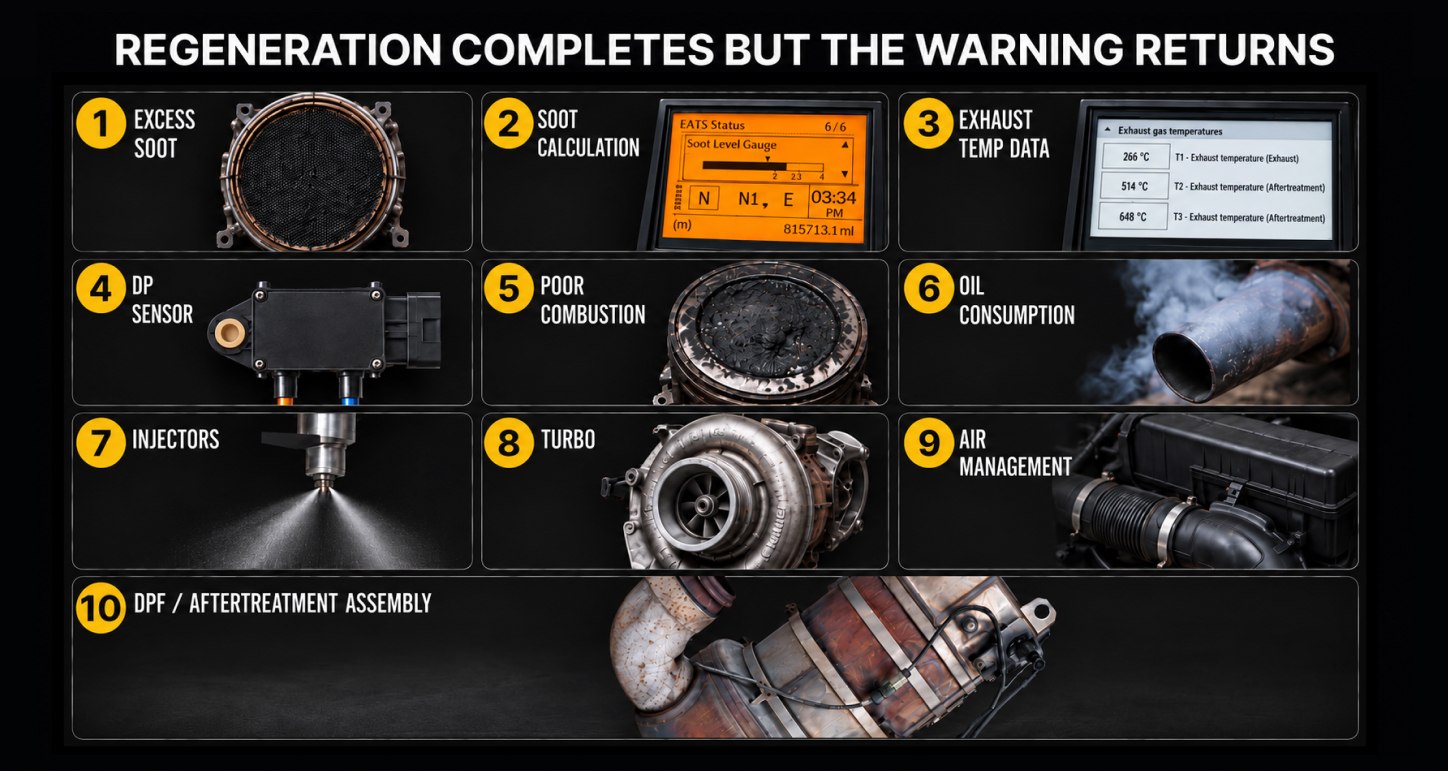
Sometimes the regeneration appears successful. The soot level decreases, the truck returns to normal operation, and the warning disappears.
Then, after relatively little driving, the DPF warning returns.
This is one of the most important symptoms because it suggests that regeneration may only be treating the **result**, not the **cause**.
### **Why does the Volvo D13 need another regen so soon?**
Possible causes include:
- Excessive soot production from the engine.
- Incorrect DPF soot calculation.
- Incorrect exhaust temperature information.
- Faulty differential-pressure sensor.
- Poor combustion.
- Excessive oil consumption.
- Injector problems.
- Turbocharger problems.
- Air-management problems.
- DPF restriction or ash accumulation.
- Regeneration that technically completed but did not remove the expected amount of soot.
Volvo has documented D13-related diagnostic codes for **P2459 — DPF regeneration frequency**, **P24A4 — DPF restriction/soot accumulation too high**, and **P249F — excessive time to enter closed-loop DPF regeneration control**.
### **Do not confuse soot with ash**
A DPF can accumulate both soot and ash, but they behave differently.
**Soot can be removed through regeneration.**
**Ash does not simply burn away during regeneration.**
As ash accumulates, the usable volume of the filter decreases and exhaust restriction can increase. Volvo documentation notes that excessive ash accumulation can require DPF replacement.
Therefore, a DPF that repeatedly requires regeneration may eventually need physical inspection, cleaning or replacement rather than another forced regeneration.
## **4\. Volvo D13 Regen Happens Too Frequently**
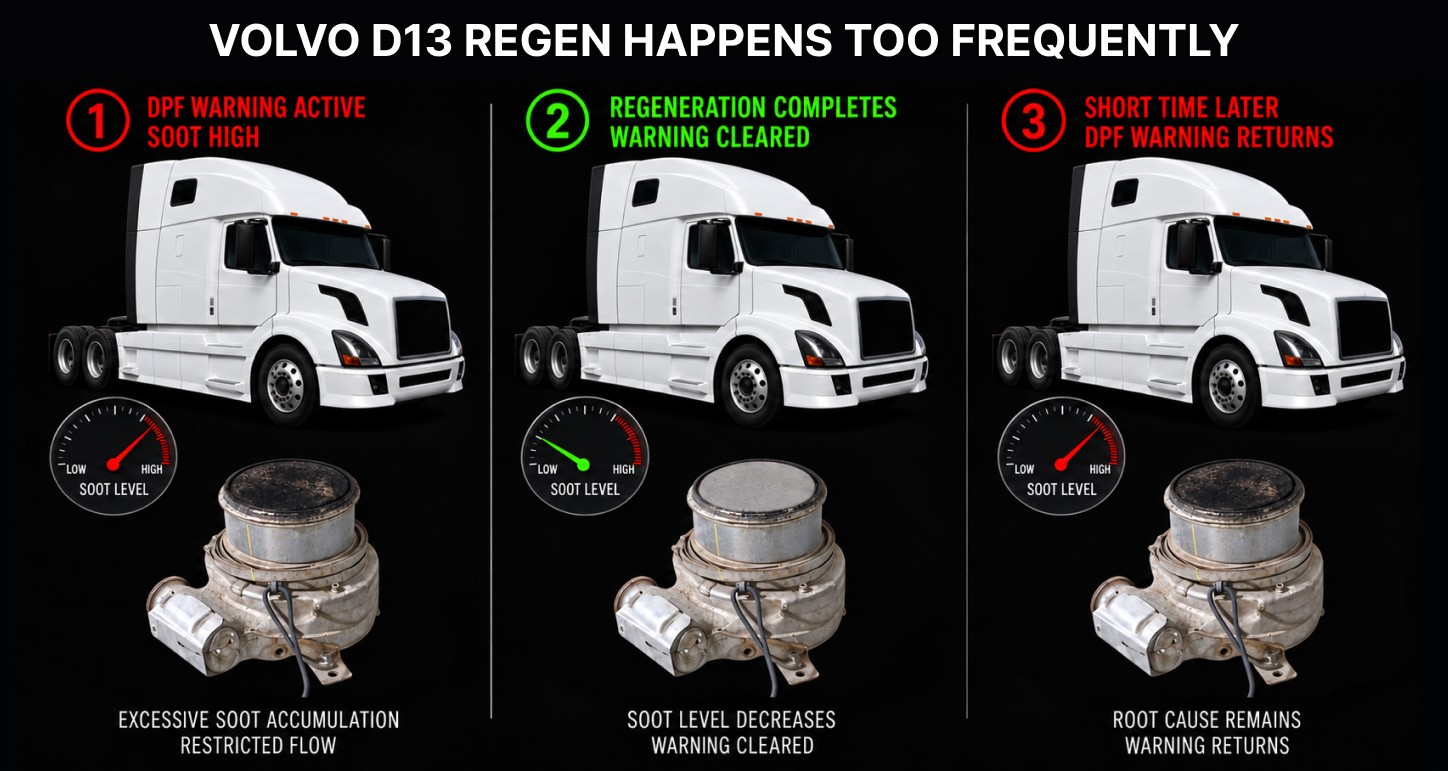
A **Volvo D13 frequent regen** problem is often more useful diagnostically than a single failed regeneration.
If the truck repeatedly regenerates after relatively short intervals, ask: **Why is the engine producing or accumulating soot faster than expected?**
Frequent regeneration can be caused by the DPF itself, but it can also originate upstream.
### **Engine-related causes**
Look for problems involving:
- Fuel injectors.
- Air intake system.
- Turbocharger.
- Boost pressure.
- EGR operation.
- Engine oil consumption.
- Combustion quality.
- Incorrect engine operating conditions.
For example, Volvo documentation lists boost-control and injector-related faults alongside DPF regeneration and soot-accumulation faults in D13 diagnostic information.
### **Exhaust and aftertreatment causes**
Also investigate:
- DPF differential pressure.
- Temperature sensors.
- Hydrocarbon doser.
- Exhaust leaks.
- DPF ash accumulation.
- Catalyst condition.
- ACM/ECM-related faults.
### **Duty cycle matters**
A truck operating primarily at low load, low speed or with frequent stops may have very different regeneration behavior from a truck spending most of its time at highway speeds and higher engine loads.
Short trips and low-temperature operation can make it harder for the aftertreatment system to complete regeneration normally.
### **Did You Know?**
Volvo describes regeneration as a controlled high-temperature process. For Volvo truck applications, parked regeneration is intended to be performed while the vehicle remains stationary, and the system can display a specific parked-regeneration requirement when driver intervention is needed.
## **5\. What Parameters Should You Check Before Replacing the DPF?**
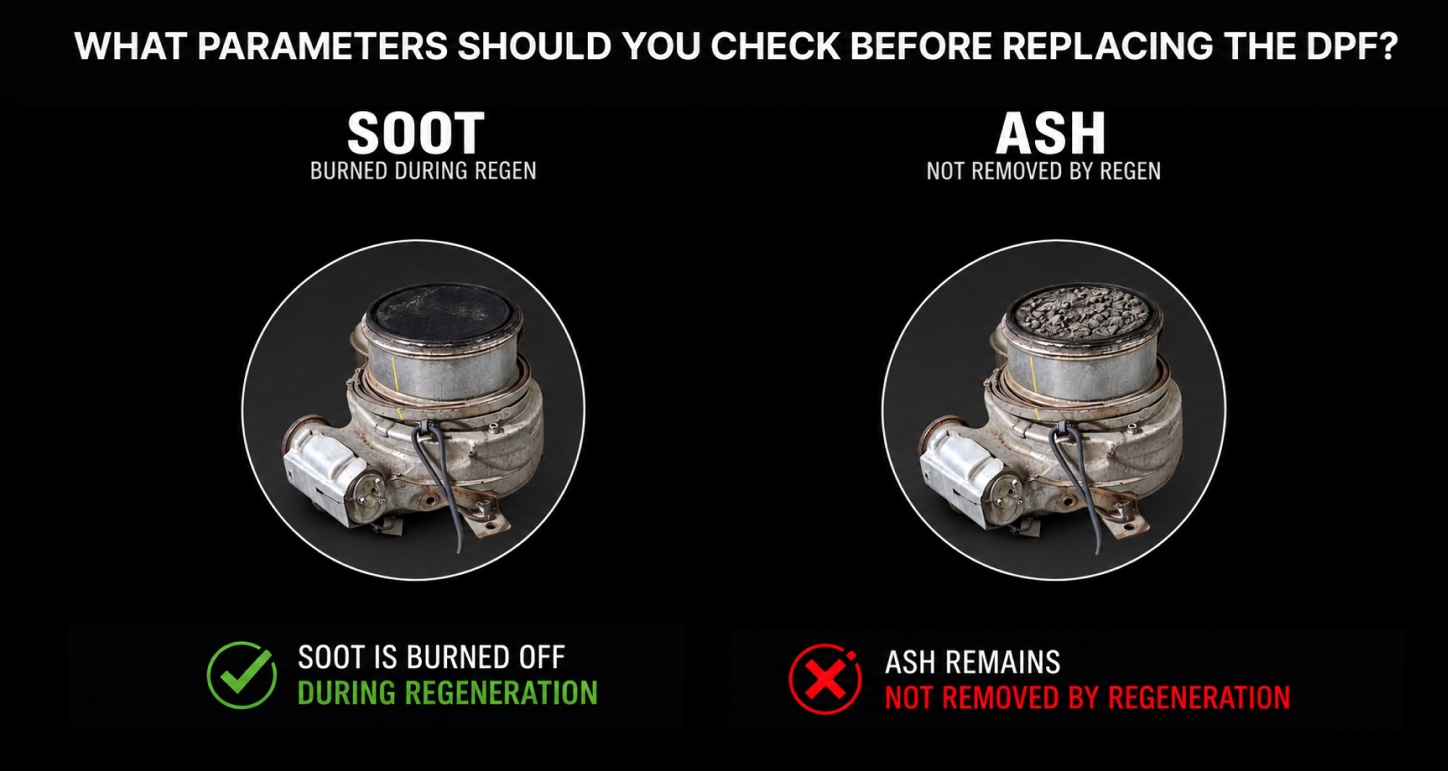
Replacing a DPF should generally be the **result of diagnosis**, not the first diagnostic step.
Before installing an expensive replacement filter, record the available aftertreatment parameters with the engine cold and at operating temperature.
### **Key parameters to check**
| **Parameter** | **What it can tell you** |
| --- | --- |
| DPF calculated soot level | How heavily the ECM believes the filter is loaded |
| DPF differential pressure | Indicates exhaust restriction and pressure-sensing behavior |
| Exhaust temperature sensors | Confirms whether regeneration temperature can be achieved |
| Engine coolant temperature | Helps determine whether the engine reaches normal operating temperature |
| Regen status | Shows whether regeneration is requested, active, inhibited or completed |
| Regen inhibit status | Identifies conditions preventing regeneration |
| Regen duration | Helps identify repeated incomplete cycles |
| Fuel dosing status | Confirms whether the system is providing the heat-generation strategy |
| Engine load | Helps explain regeneration behavior |
| Boost pressure | Can reveal engine/air-system problems contributing to soot production |
| Injector-related data/DTCs | Helps identify excessive or abnormal fueling |
| DPF ash/service history | Helps distinguish soot loading from long-term ash accumulation |
| ECM/ACM software level | Software updates may address known aftertreatment control issues |
Volvo has issued service information for D11/D13/D16 vehicles in which ECM and ACM software updates addressed multiple DPF and regeneration-related DTCs, including P2459, P24A0, P24A4 and P249F.
### **Do not reset the soot value just to make regeneration possible**
This is particularly important.
Volvo's Premium Tech Tool documentation states that the DPF soot level is calculated from multiple inputs and that a soot-level reset should only be performed after the DPF has actually been serviced or replaced. Resetting the value without servicing the filter can disrupt regeneration and contribute to premature DPF overloading or damage.
**IMPORTANT:** A soot reset is not a repair. If the DPF has not been cleaned or replaced, resetting the calculated soot value only hides the problem from the control system temporarily.
## **Volvo D13 DPF Regeneration Diagnostic Sequence**
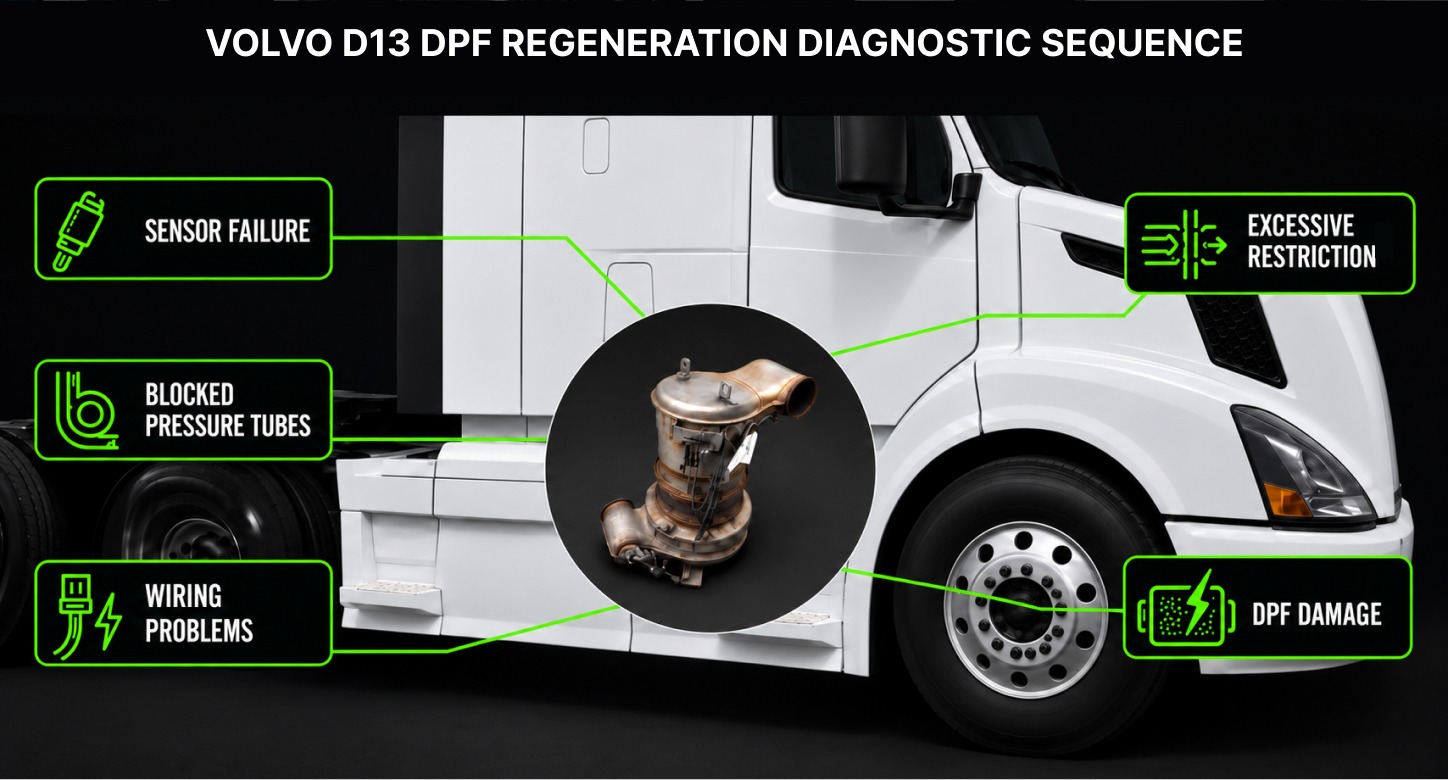
When dealing with **Volvo D13 regen failed**, use a logical sequence rather than replacing components at random.
### **Step 1 —** [**Read all active faults**](https://dl.ge/catalog/truck-ecm-tuning/fault-codes-reading/)
Start with ECM and ACM diagnostics.
Do not focus only on the DPF-related code. An engine, turbocharger, injector, temperature or air-management fault may be the actual reason regeneration cannot complete.
### **Step 2 — Check regeneration criteria**
Determine exactly why the system is allowing or blocking regeneration.
If the truck **will not do parked regen**, the regeneration criteria are one of the first things to investigate.
### **Step 3 — Check soot level and differential pressure**
Compare calculated soot loading with actual differential-pressure behavior.
An abnormal pressure reading can point toward:
- Sensor failure.
- Blocked pressure tubes.
- Wiring problems.
- Excessive restriction.
- DPF damage.
### **Step 4 — Verify temperature**
Check the exhaust temperature sensors before and during regeneration.
If the ECM calls for regeneration, but temperature doesn’t increase like it is supposed to, look at the heat-generation system instead of performing the regeneration command again.
### **Step 5 — Check fuel dosing**
Verify that the aftertreatment dosing system is capable of supplying fuel correctly.
A regeneration that repeatedly begins but cannot maintain temperature deserves particular attention here.
### **Step 6 — Investigate the engine**
If regeneration completes but the **Volvo D13 frequent regen** problem remains, investigate why soot is being generated excessively.
Look at fuel, air, boost, EGR, injector and oil-consumption-related conditions.
### **Step 7 — Evaluate the DPF itself**
Only after the surrounding system has been checked should you determine whether the DPF requires:
- Cleaning.
- Inspection.
- Replacement.
## **Volvo D13 DPF Regeneration: Problem → Diagnosis → Solution**
The easiest way to approach a regeneration complaint is to classify the symptom first.
| **Symptom** | **First diagnostic direction** | **Possible solution** |
| --- | --- | --- |
| Regen does not start | Check criteria and active DTCs | Correct the condition blocking regen |
| Parked regen unavailable | Check regen enable/inhibit status | Resolve inhibit condition |
| Regen starts then stops | Check temperature, pressure and dosing | Repair the failed subsystem |
| Regen completes but warning returns | Check soot production and DPF condition | Find root cause; inspect DPF |
| Regen happens too often | Check engine and aftertreatment parameters | Correct excessive soot production or restriction |
| Soot level remains high | Verify soot calculation and differential pressure | Diagnose restriction/sensor issue |
| Temperature stays low | Check EGT sensors, dosing and engine conditions | Restore proper regeneration temperature |
| DPF pressure remains high | Check DPF restriction and pressure sensing | Repair sensing system or service DPF |
The central idea is simple:
**A regeneration failure is a symptom. The diagnostic goal is to find the condition that prevented the regeneration from working correctly.**
## **When Should You Stop Trying to Regenerate the DPF?**
Repeated regeneration attempts are not an unlimited solution.
If soot loading is critical, the system may prevent normal parked regeneration and require professional service. Volvo documentation distinguishes ordinary parked regeneration from service regeneration and identifies critical soot conditions where technician intervention is required.
You should be most vigilant in the following situations:
- DPF soot level is at or above the permitted limit.
- Differential pressure is abnormally high.
- Regeneration repeatedly fails.
- Regeneration stops because temperature cannot be maintained.
- The DPF warning returns immediately after regeneration.
- The truck enters a derate condition.
- There are multiple active engine or aftertreatment faults.
It is becoming more dangerous to override regeneration without finding the root cause at this point. It can cause thermal stress and damage the aftertreatment system.
## **Final Takeaway**
When a **Volvo D13 DPF regeneration fails**, the most important question is not simply _“How do I force another regen?”_
The better question is:
**“Why can't the system complete regeneration under the conditions the ECM expects?”**
For a **Volvo D13 regen not working**, start with regeneration criteria and active DTCs. If the **Volvo D13 regen stops**, focus on temperature, differential pressure and fuel dosing. If the **Volvo D13 regen happens too often**, investigate soot production, engine operation and DPF condition.
And before replacing the DPF, verify the data that the ECM is using to control regeneration.
A correct diagnosis can prevent an unnecessary DPF replacement—and can also prevent a new DPF from being damaged by the same unresolved problem that caused the original failure.
## **FAQ**
### **Why is my Volvo D13 regen not working?**
Common causes include active fault codes, regeneration inhibit conditions, excessive soot loading, insufficient exhaust temperature, sensor problems, fuel-dosing faults and engine-related issues.
### **Why will my Volvo D13 not do parked regen?**
The system may be blocking parked regeneration because one or more required criteria are not satisfied. Check the regeneration criteria, active DTCs, soot level and regeneration enable/inhibit status.
### **Why does my Volvo D13 regeneration stop?**
A regen can stop when the system cannot maintain the required exhaust temperature or detect an abnormal pressure, sensor, dosing or engine condition.
### **What does high Volvo D13 DPF soot level mean?**
A high calculated soot level means the ECM believes substantial particulate accumulation has occurred. If the level becomes critical, normal regeneration may no longer be sufficient and service intervention may be required.
### **Why does my Volvo D13 regenerate frequently?**
Frequent regenerations can be caused by various factors, among them an operating duty cycle, abnormally high soot production, incorrect readings by the sensors, engine problems, a blocked DPF or other aftertreatment problems.
## Sources
- [Regeneration control for DPF](https://stpi.it.volvo.com/STPIFiles/Volvo/FactSheet/DRC-AMII_Eng_03_338853982.pdf) — Volvo Trucks, DRC-AMII, ENG Version 03, February 26, 2024, p. 1
- [Exhaust Aftertreatment System Fault Tracing](https://www.hhrvresource.com/VolvoDocsGenII/Volvo%20Engine%20Manuals/D11/Exhaust%20Aftertreatment%20System%20Fault%20Tracing.pdf) — Volvo Trucks North America, Group 258, No. 45, March 2008, D11F/D13F/D16F, pp. 3–5
- [Driver’s Handbook — VOLVO D13H Engine Operator’s Manual](https://techpub.prevostcar.com/content/media/18702/view) — Volvo Bus Corporation, 89012817, 2011, pp. 37–38
- [Body Builder Instructions — Engine, General Information](https://www.volvotrucks.us/media/vtna/files/shared/body-builder/manuals/2026/volvo-section-2-engine-approved.pdf) — Volvo Trucks North America, VN(4), Section 2, USA191926741, November 2025, pp. 11–12
- [Volvo Trucks Driver Guide — Active Regeneration](https://driverguide.volvotrucks.us/lang/en/chassi/NRVNL440/topic/296569) — NRVNL440, Conditions to Start Regeneration and Active Regeneration DID Notifications
- [Engine control module (ECM), diagnostic trouble codes](https://es.class8truckparts.com/media/file/ecm-diagnostic-trouble-codes.pdf) — Volvo IMPACT 4.07.82, Identity 140225418, print November 19, 2020, pp. 87–90
- [Engine Control Module (ECM), Aftertreatment Control Module (ACM) Diagnostic Trouble Codes](https://class8truckparts.com/media/file/PV776-89149152.pdf) — Volvo Trucks, Group 28, PV776-89149152, Release 02, P24A2, pp. 80–81
- [Premium Tech Tool: Frequently Asked Questions](https://www.volvotrucks.us/volvo-premium-tech-tool/media/faqs/tech-tool-faqs-march-2024.pdf#page=20) — March 2024, How can I manually reset the soot level?
- [Engine Control Module (ECM) and Aftertreatment Control Module (ACM), Reprogramming](https://static.nhtsa.gov/odi/tsbs/2018/MC-10142790-9999.pdf) — FSB 284-064, Release 02, June 2018, OBD2015, pp. 1–2
- [Engine Control Module (ECM) and Aftertreatment Control Module (ACM), Reprogramming](https://static.nhtsa.gov/odi/tsbs/2018/MC-10142791-9999.pdf) — FSB 284-065, Release 02, June 2018, OBD2016, pp. 1–2
- [Remote Diagnostics Repair Instructions — Particulate Filter Restriction - Soot Accumulation Bank 1](https://static.nhtsa.gov/odi/tsbs/2020/MC-10173498-0001.pdf) — Volvo RD17-026, DTC P2463-00, August 16, 2018, US13–US20 Emissions
- [Volvo Chassis - Vehicle with Diagnostic Trouble Code (DTC) P2002-00, Diagnostic Instructions](https://static.nhtsa.gov/odi/tsbs/2019/MC-10165224-9999.pdf) — Volvo K70734554, 13L, US10+OBD13, model years 2013 (rare) and 2014
- [Effect of regeneration method and ash deposition on diesel particulate filter performance: a review](https://pubmed.ncbi.nlm.nih.gov/36820972/) — Luo et al., Environmental Science and Pollution Research, 2023, pp. 45607–45642, abstract
Sources last checked: 2026-05-08
[Tech Guides](https://volvodpfdelete.com/tech-guides/)
## Related reading
[All articles](https://volvodpfdelete.com/search/)

Tech Guides/D13
### [Volvo P24A0 and P249F: Low-Temperature DPF Regeneration Diagnosis]()
Volvo D13 codes P24A0 and P249F point to problems with regeneration temperature control. Learn how to verify the fault in Premium Tech Tool and check the 7th injector, DOC, and exhaust temperature sensors before replacing parts.
Read guide

Tech Guides/D13
### [Anatomy of the Volvo D13: Why This Diesel Became an Industry Standard]()
What made the Volvo D13 a familiar engine in heavy-duty trucking? This overview covers its specifications, horsepower, low-RPM torque, fuel economy, reliability, and common problem areas. It also explains why engine generation, maintenance history, and the truck’s supporting systems matter when evaluating a D13.
Read guide

Tech Guides/D13
### [Volvo D13 DPF Differential Pressure Sensor Diagnostics: High Delta P vs. Blocked Tubes]()
Learn how to check the Volvo D13 DPF differential pressure sensor, tubes, and fittings, and use PTT live data to determine whether the filter is restricted.
Read guide
[Explore all articles](https://volvodpfdelete.com/search/)