
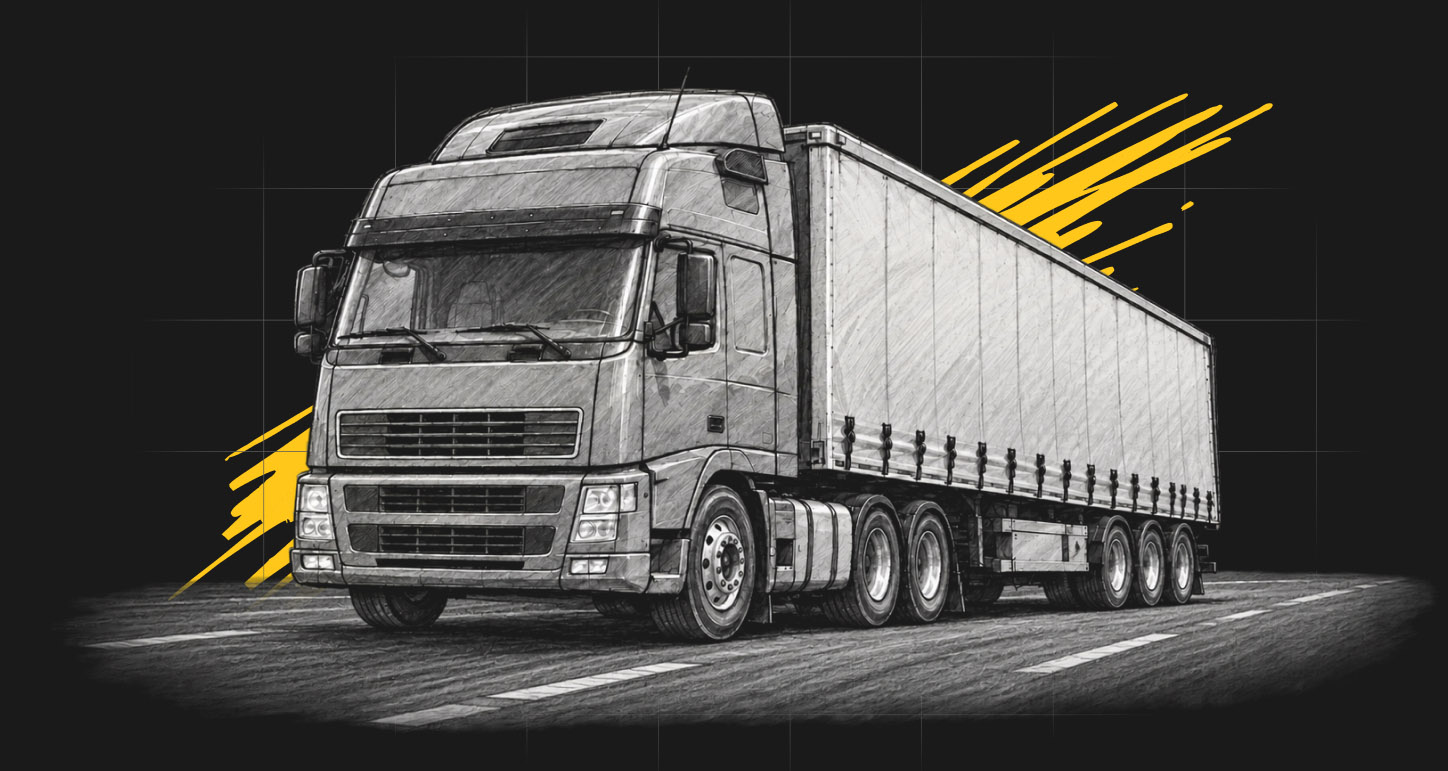
Volvo D12: The Iron Legend of the '90s That Still Makes a Living for Truckers

Is the Volvo D12 a reliable engine?
Yes. Volvo D12 engines earned a reputation for durability and long service life. In heavy-duty, on-highway applications, D12 engines were known to handle high mileage and continuous loads. Because of this, many D12-powered Volvo trucks are still in service. Of course, the condition of a used D12 depends heavily on its maintenance history, mileage, and how the truck was operated.
The Volvo D12 is a good example of an engine that became more than just a powerplant. For many truckers, it became part of the truck they knew how to operate, maintain, and keep earning with.
A 12-Liter Workhorse That Refused to Disappear
The Volvo D12 arrived in the 1990s, at a time when heavy-duty diesel engines were going through a major transition. Electronic engine controls were becoming increasingly important, while truck manufacturers were looking for more power, better fuel efficiency, and improved control over engine performance.
Volvo's answer was the D12 — a 12.1-liter inline-six designed for heavy-duty trucks.
It became a familiar sight in Volvo FH, FH12, FM and other heavy-duty applications. Over the years, Volvo continued developing the engine, increasing power and torque while updating its electronic control and emissions technology.
Today, the D12 is old by modern diesel standards. But old does not necessarily mean useless.
There are still plenty of trucks on the road where the D12 is doing exactly what it was designed to do: pulling freight.
Volvo D12 Engine Specs
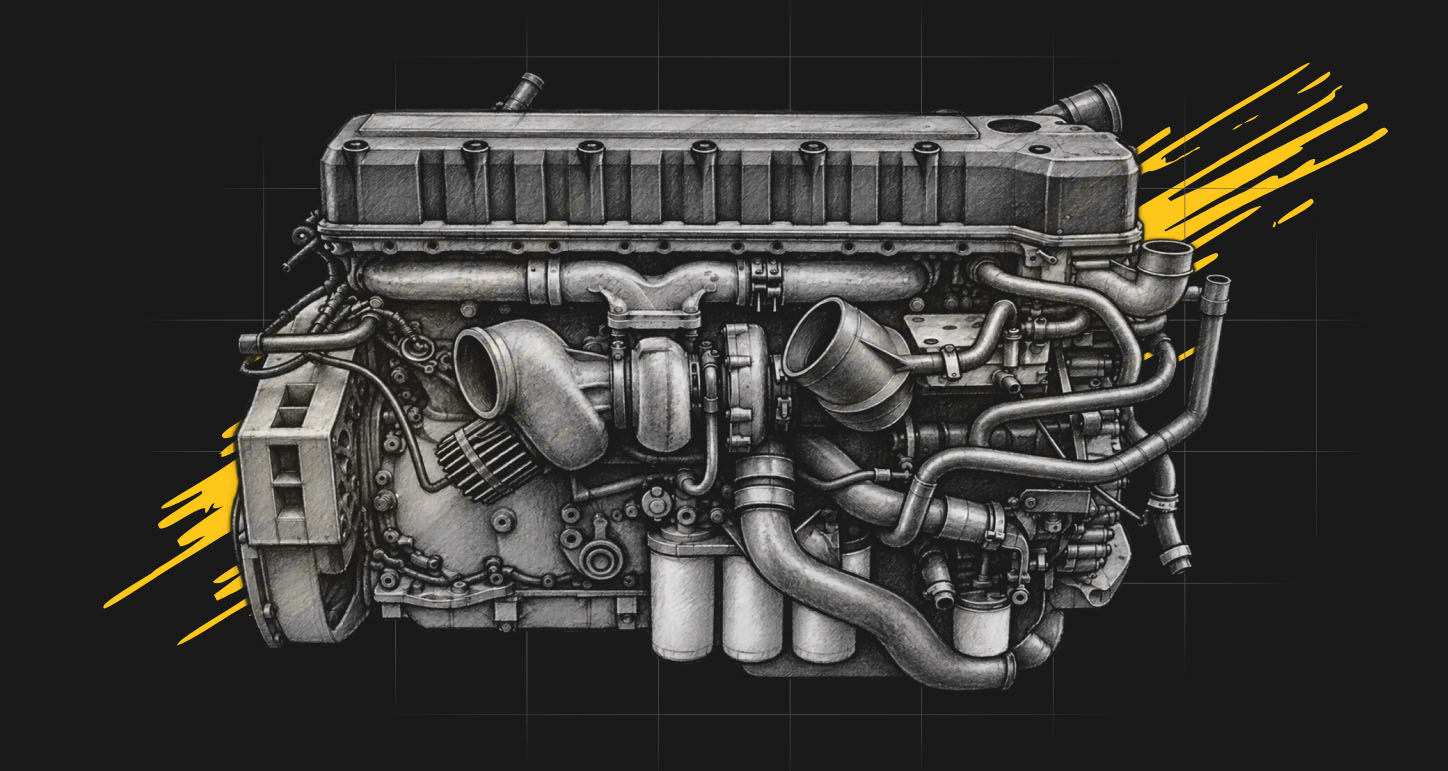
The basic D12 formula was straightforward: a large-displacement inline-six diesel, turbocharging, charge-air cooling, and an engine architecture designed for heavy commercial use.
Exact specifications depend on the generation and calibration, but the basic platform remained recognizable throughout its development.
Specification | Volvo D12 |
Engine type | Inline 6-cylinder diesel |
Displacement | 12.1 L |
Aspiration | Turbocharged |
Charge air | Air-to-air cooled |
Valvetrain | 4 valves per cylinder |
Application | Heavy-duty commercial trucks |
Production era | 1990s–2000s |
One important thing to remember when looking up Volvo D12 engine specs is that "D12" does not describe one single configuration. Volvo produced several versions of the engine, and specifications changed as the engine evolved.
That is why two D12 trucks can have noticeably different horsepower and torque figures.
Volvo D12 Horsepower
So, how much horsepower does a Volvo D12 have?
There is no single answer.
Depending on the generation and calibration, D12 engines were offered with outputs ranging from roughly 350 hp to 500 hp. Some of the later and more powerful versions reached the upper end of that range.
That was a substantial amount of power for a heavy-duty diesel of its era.
The higher-output versions were designed for demanding applications where maintaining speed under load mattered just as much as getting the truck moving.
For buyers looking at an older Volvo today, the engine's exact model and rating are more useful than simply seeing "D12" on the truck.
Volvo D12 Engine Torque Specs
Horsepower gets most of the attention, but truckers know that torque is where a heavy-duty diesel earns its keep.
Depending on the version, the Volvo D12 produced approximately 1,200–1,850 lb-ft of torque.
That broad torque range reflects the many versions Volvo produced over the D12's lifetime.
The engine was designed to deliver strong low- and mid-range pulling power, which made it well suited to heavy loads, highway grades, and long-distance operation.
For a truck engine, that matters more than a big horsepower number sitting at the top of the tachometer.
Why Did the Volvo D12 Become So Popular?
The D12 arrived at the right time.
Volvo needed an engine that could compete in the increasingly demanding heavy-duty truck market, and the D12 gave the company a platform it could continue developing for years.
Several things worked in its favor:
12.1-liter displacement provided plenty of working capacity.
Inline-six design was well suited to heavy-duty applications.
Strong torque output made it useful for loaded highway trucks.
Multiple power ratings allowed Volvo to use the platform across different applications.
Electronic engine management gives Volvo finer control over fuel delivery and the operation of the engine.
Long production life helped establish a large population of D12-powered trucks.
The result was an engine that became familiar to fleets, independent truckers, and technicians across multiple markets.
Volvo D12 Engine Reliability
The Volvo D12's reputation for reliability is one of the main reasons it is still discussed decades after its introduction.
But there is an important distinction between a reliable engine design and a reliable 20- or 30-year-old engine.
Age changes everything.
A D12 with a good maintenance history and reasonable operating conditions can continue to be a productive engine. Another D12 with years of hard use, neglected maintenance, or poorly maintained supporting systems can become expensive to keep on the road.
At this age, the condition of the individual engine matters more than the badge on the valve cover.
That is also why mileage alone does not tell the whole story when evaluating an older D12 truck.
Volvo D12 Engine Problems
Searching for Volvo D12 engine problems brings up a long list of potential issues. But there is no single failure that defines the D12.
Most concerns found on older D12-powered trucks fall into a few broad categories.
Fuel-system components can develop problems with age and mileage. Turbochargers and charge-air systems can also require attention after years of heavy use. Cooling-system components, sensors, wiring, and other electronic components can develop age-related issues as well.
And then there is ordinary wear.
A truck that has spent decades hauling heavy loads will naturally have components that need attention.
The important point is that not every D12 problem means the engine itself is finished. In many cases, the engine may remain mechanically sound while supporting components become the source of trouble.
That distinction is particularly important when evaluating an older truck.
Why Are D12 Trucks Still Working?
The simplest answer is economics.
A truck that is already paid for does not have to make monthly payments on a new engine or a new chassis. If the vehicle remains productive and the owner knows its history, keeping it working can make financial sense.
There is also familiarity.
Truckers and independent owners often know their older Volvo inside and out. They know how the engine feels, how it pulls a load, what its normal operating behavior looks like, and what maintenance it needs.
That knowledge has value.
The D12 also benefits from being part of a huge population of Volvo commercial vehicles produced over many years. Parts knowledge, service information, and experience with the platform did not disappear when production ended.
In other words, the D12 survived because it earned its place.
The Volvo D12 in the Modern Used-Truck Market
A D12-powered Volvo is obviously not going to offer the same technology, emissions equipment, or electronic architecture as a modern heavy-duty truck.
But that is not necessarily why someone buys one.
For an owner-operator looking for an older truck, the attraction can be simple: a proven heavy-duty engine, a familiar platform, and a truck that can still generate revenue without the cost of a brand-new vehicle.
The key is knowing exactly which D12 version is installed and what condition the complete truck is in.
The engine is only one part of the equation.
Can a Volvo D12 Still Be Tuned?
Modification of some D12 applications can be done through ECU programming, based on the engine, ECU, truck configuration, and intended use.
However, tuning an older commercial engine should be based on its actual configuration rather than simply choosing a horsepower number.
For owners considering remote ECU tuning, the exact engine and ECU information should be confirmed first. A professional calibration can then be discussed based on what the particular truck supports.
For older Volvo trucks, this can be one way to keep an otherwise useful platform working efficiently for longer.
Final Thoughts
The Volvo D12 is old-school diesel engineering, but its story is not over.
It was introduced in the 1990s, developed through multiple generations, installed in thousands of heavy-duty trucks, and eventually became one of the recognizable Volvo diesel engines of its era.
Its horsepower and torque numbers are only part of the story.
The real achievement of the D12 is that decades later, truckers are still putting freight behind it and going to work.
That is probably the best definition of a workhorse.
FAQ
How much horsepower does a Volvo D12 have?
Depending on the generation and engine rating, Volvo D12 engines were available with approximately 350–500 hp.
How much torque does a Volvo D12 produce?
Depending on the version, a Volvo D12 can produce approximately 1,200-1,850 lb-ft of torque.
What are the most common Volvo D12 engine problems?
Common concerns on older D12 engines can involve fuel-system components, turbocharging and charge-air systems, cooling components, sensors, wiring, and general age-related wear.
How long can a Volvo D12 engine last?
There is no set mileage limit. Service life depends on the condition of the engine, maintenance, the operating conditions, load, and many more factors. Well-maintained D12 engines can remain productive at very high mileage.
What trucks use the Volvo D12 engine?
Models of the Volvo FH/FH12 and FM trucks, built for different markets and production years, used the D12.
Is the Volvo D12 good for long-haul trucking?
Yes. The D12 was designed for heavy duty commercial use and was very popular for use in highway and long haul trucks because of the strong torque and durability.
Can a Volvo D12 be tuned?
D12 applications support ECU tuning. However, support will vary based on the engine, ECU, truck configuration and calibration. You should verify your configuration prior to selecting a tuning option.
Review
You can leave a review on the contact page.
Related Articles
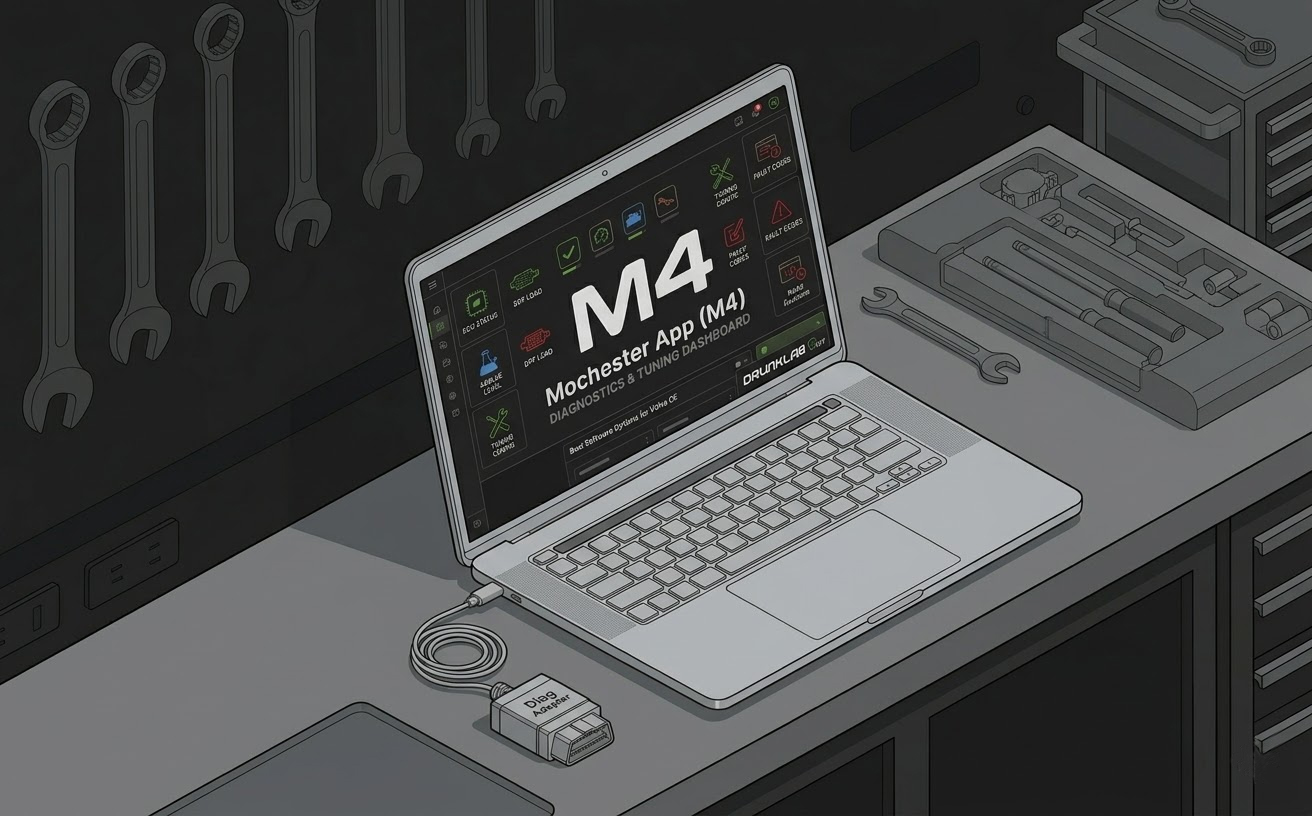
Mochester App (M4 App) for Volvo Construction Equipment: Smart Diagnostics and Tuning Made Easy
Remote tuning solutions for Volvo construction machines are available through the Mochester App (M4 App). This guide outlines the App's primary functions and how to use it to enhance the performance of your machines, minimize their downtime, and better their fuel efficiency.
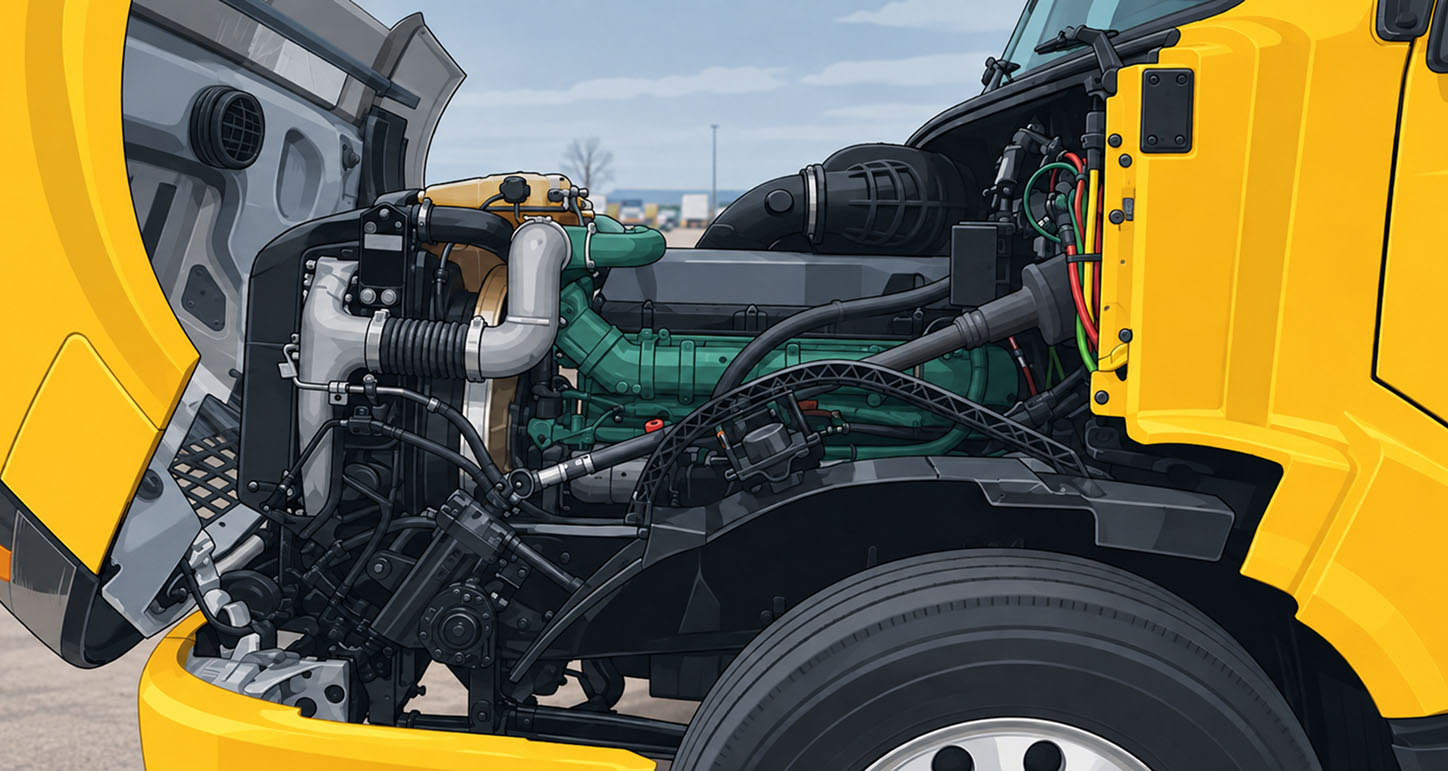
Volvo Hydrocarbon Doser (7th Injector) Faults: Why DPF Temperature Fails to Rise During Regen
Volvo DPF regeneration starts, but the temperature stays too low? Learn how to check the 7th injector, fuel pressure, dosing controls, and temperature readings before replacing parts, then verify the repair with PTT.
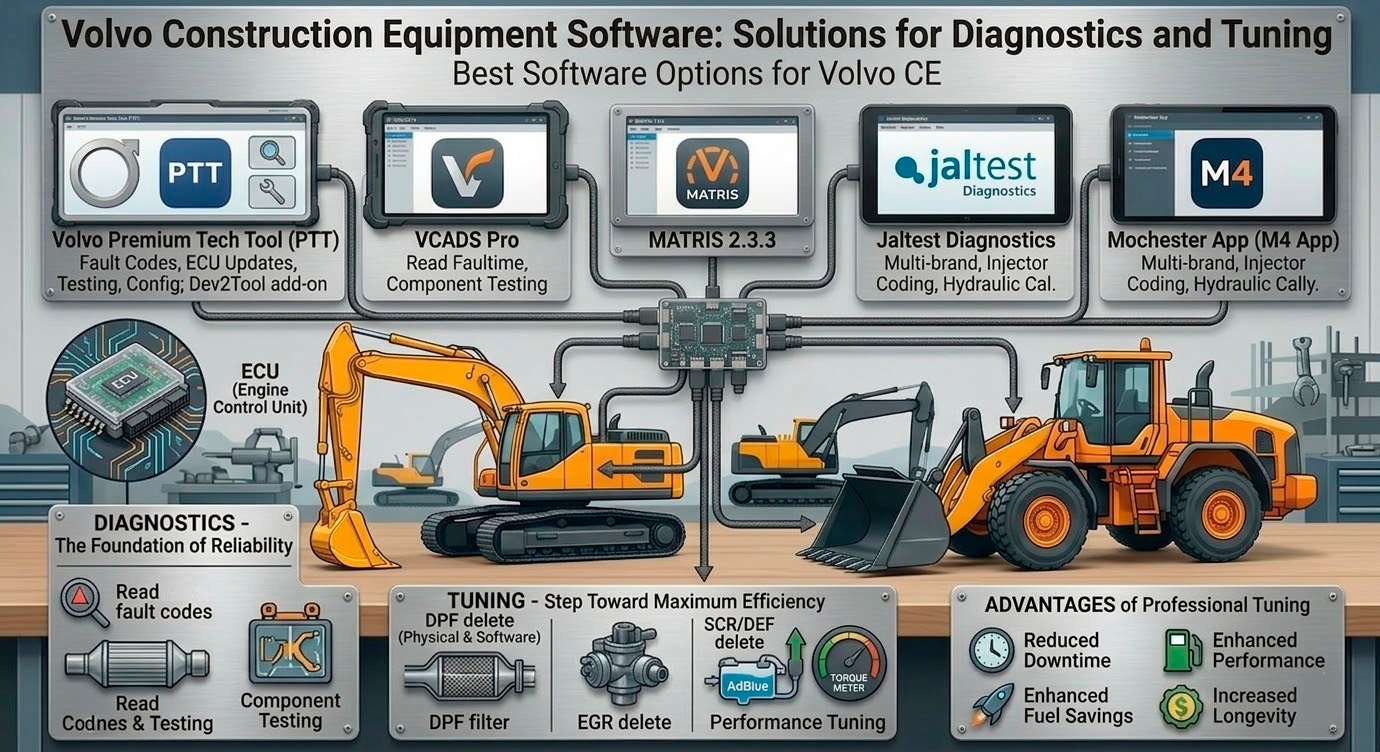
Volvo Construction Equipment Software: Solutions for Diagnostics and Tuning
Modern Volvo Construction Equipment depends on sophisticated electronic systems that use software for diagnostics and optimization. This article analyzes the most common tools such as Volvo Tech Tool, VCADS Pro, Jaltest, and Mochester App, and their functions regarding fault identification, ECU programming, and system calibration. Other tuning options including performance optimization as well as DPF, EGR, and SCR deletes are discussed. Overall, correct application of these tools and techniques can help minimize production downtime, enhance operational efficiency, and prolong the natural working life of Volvo CE equipment.